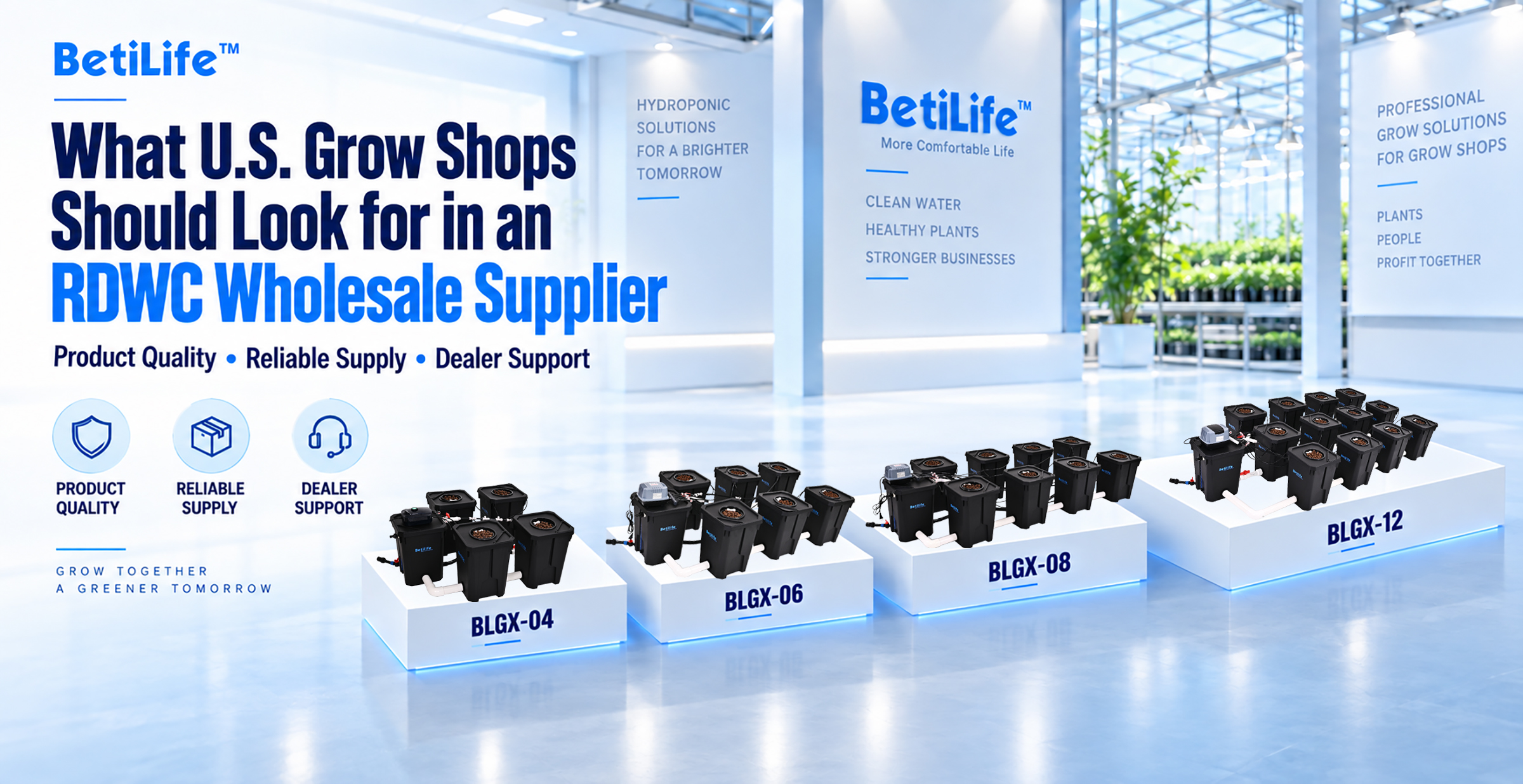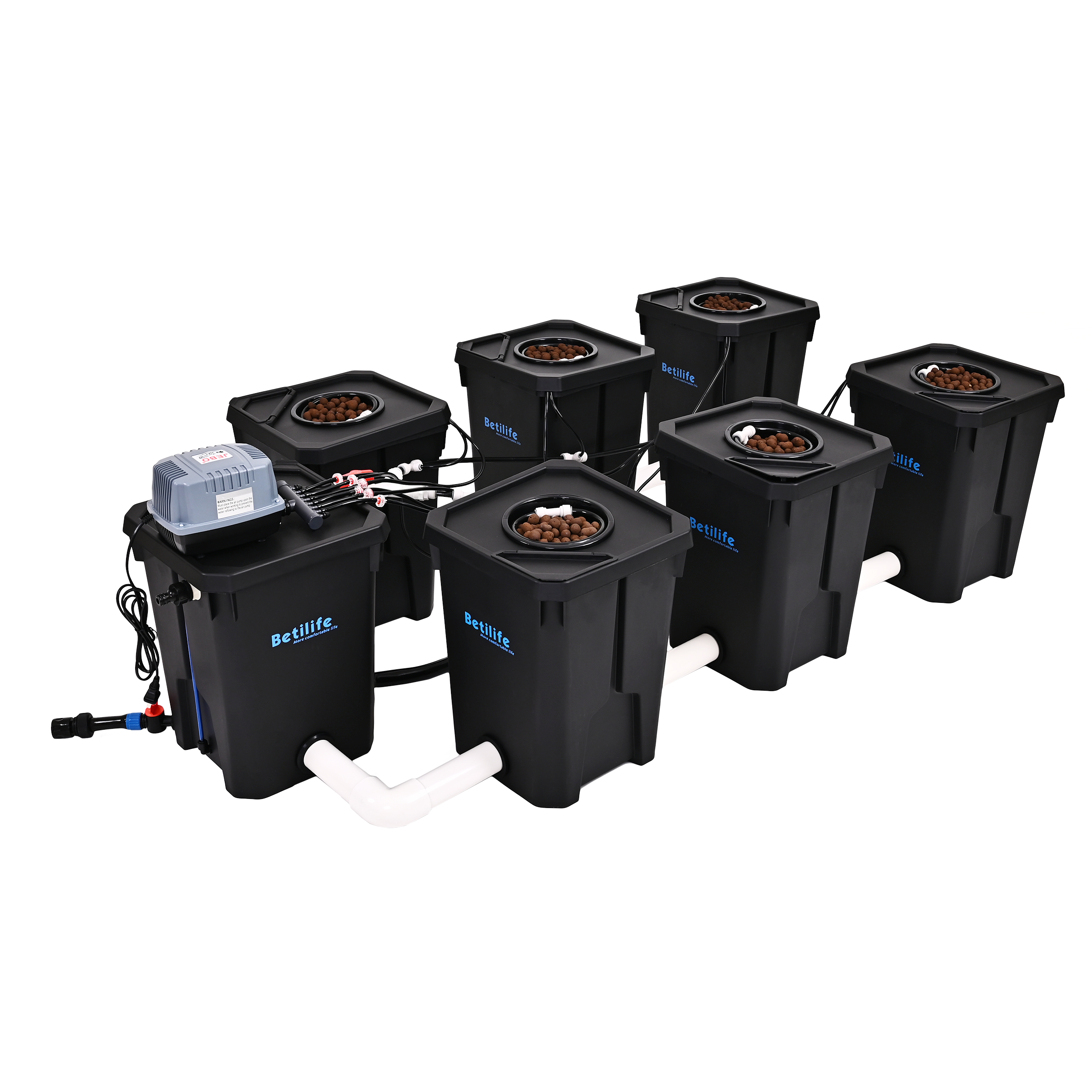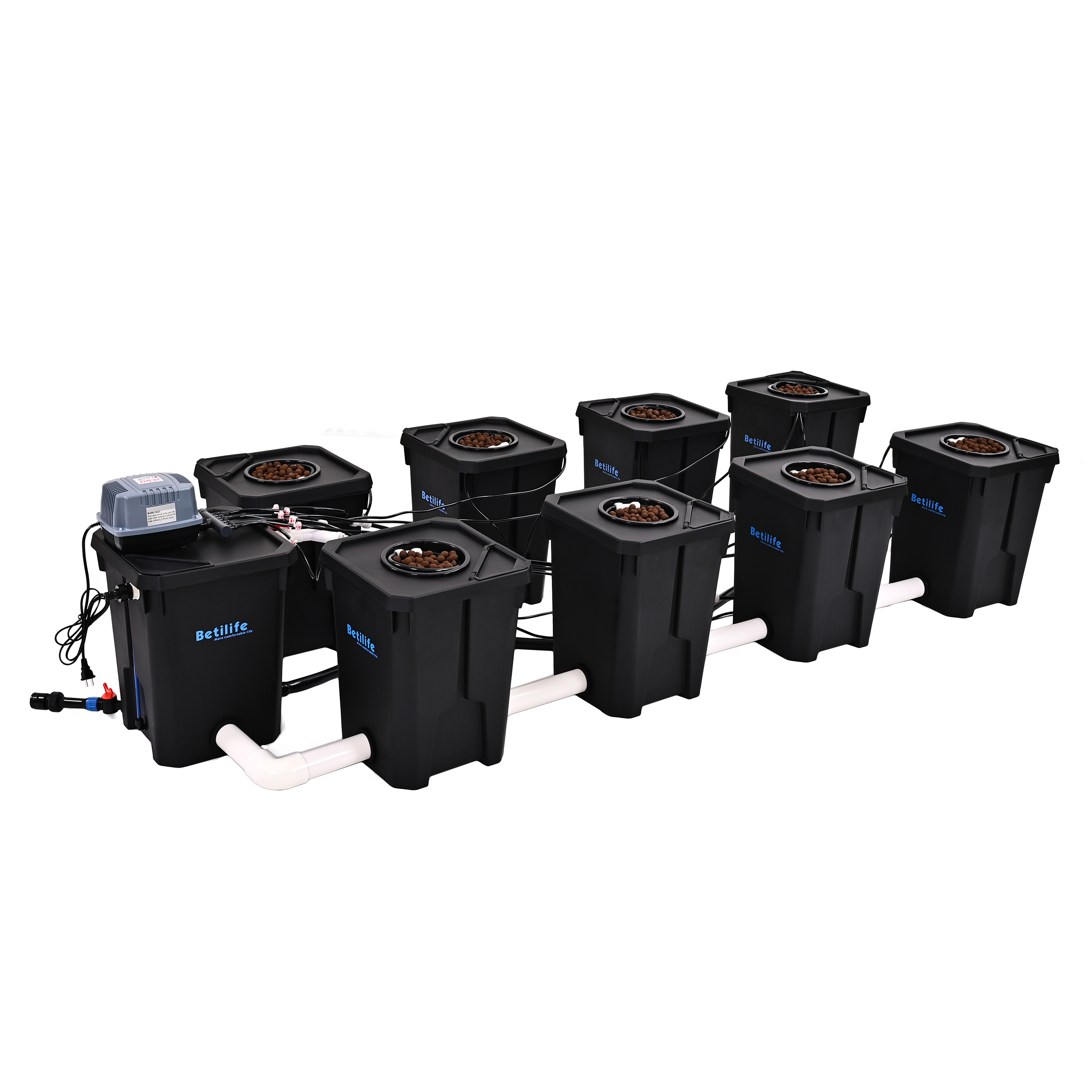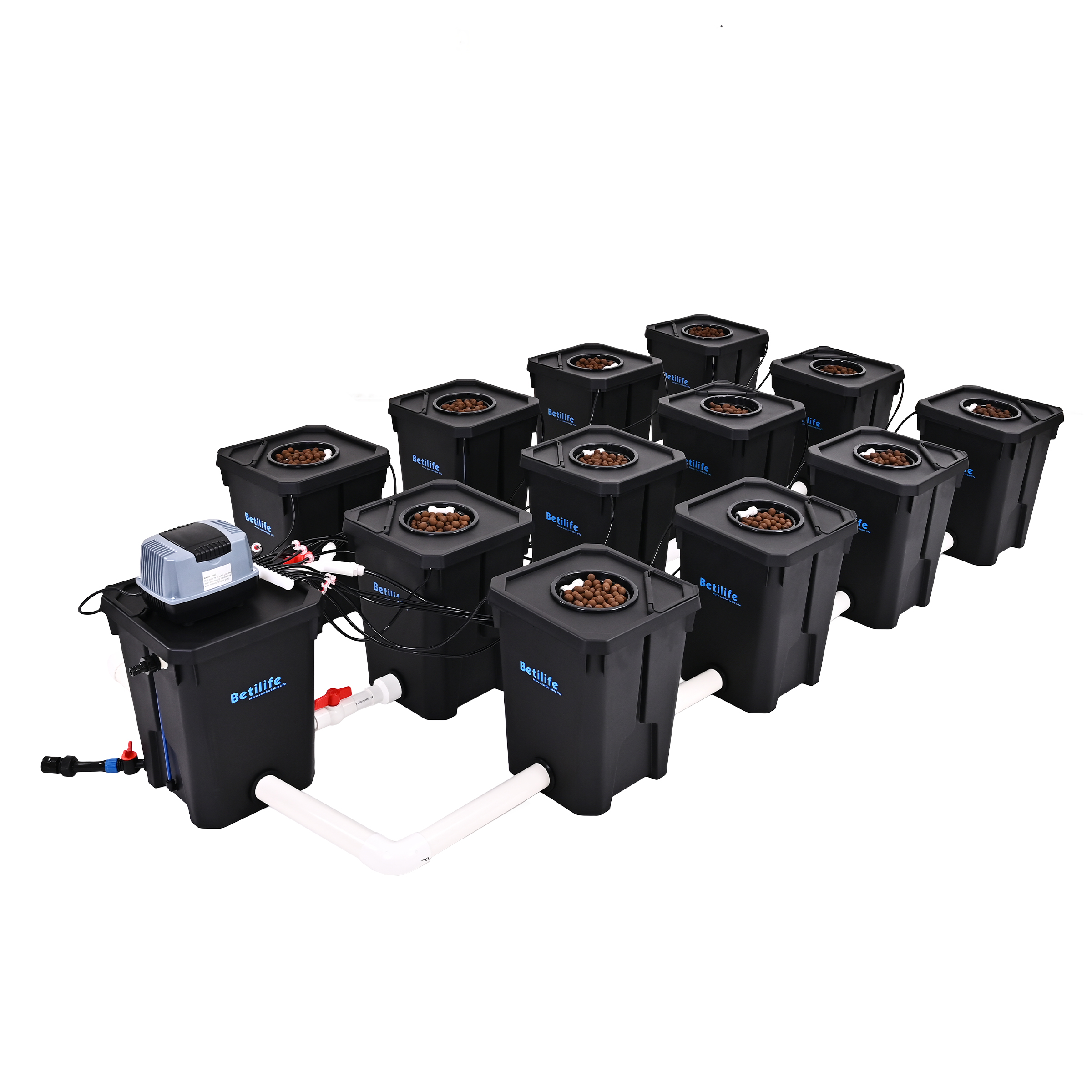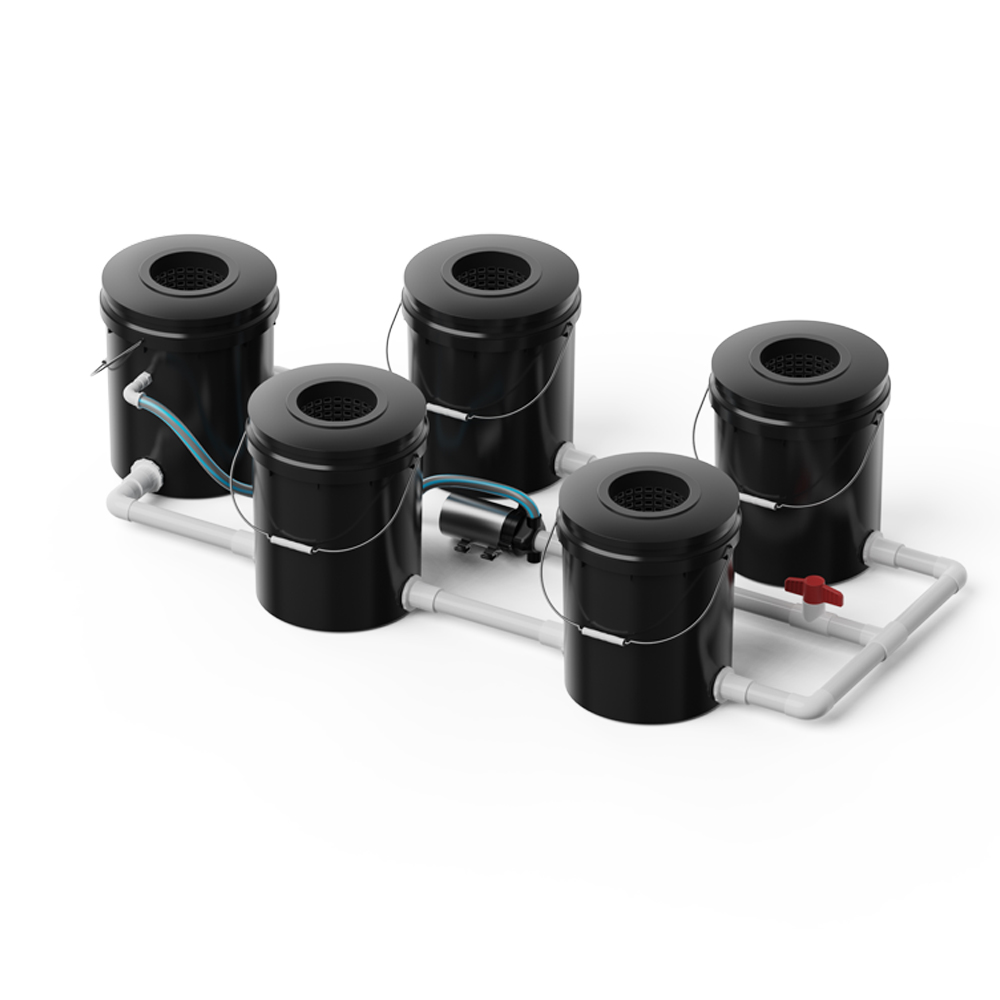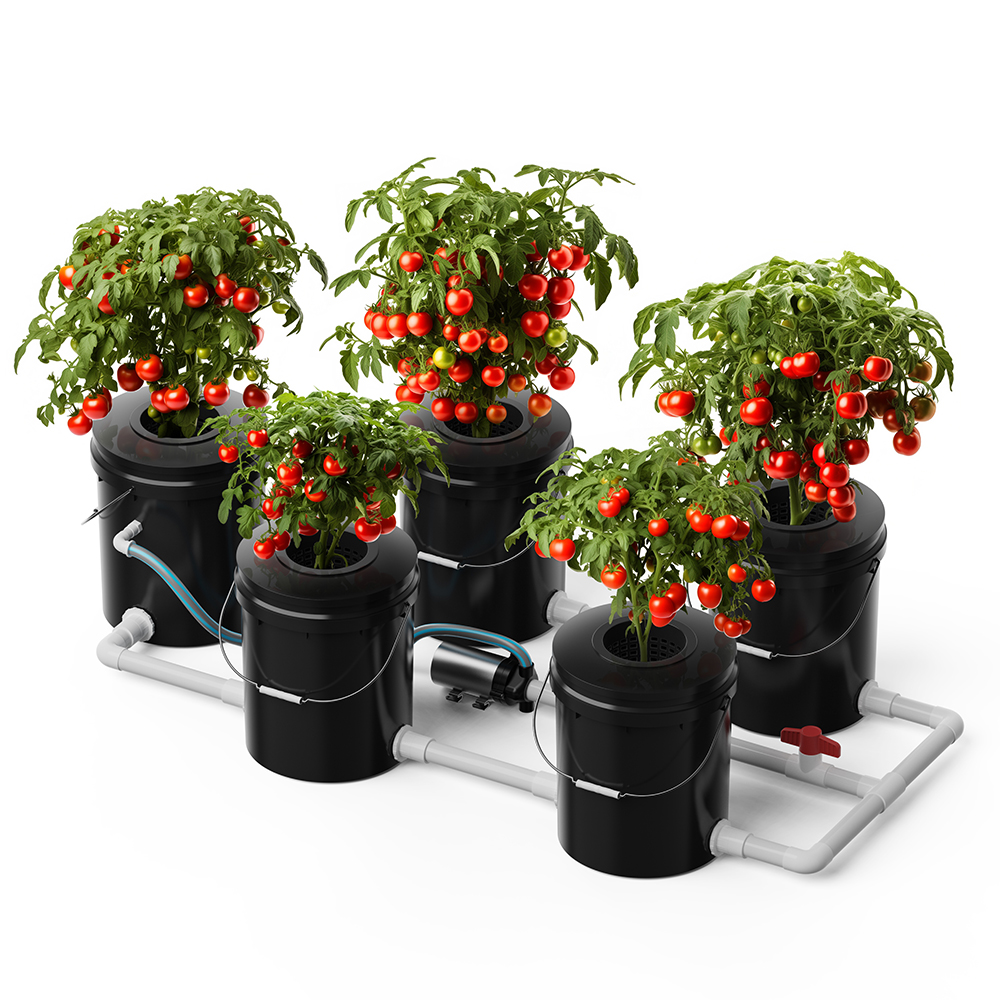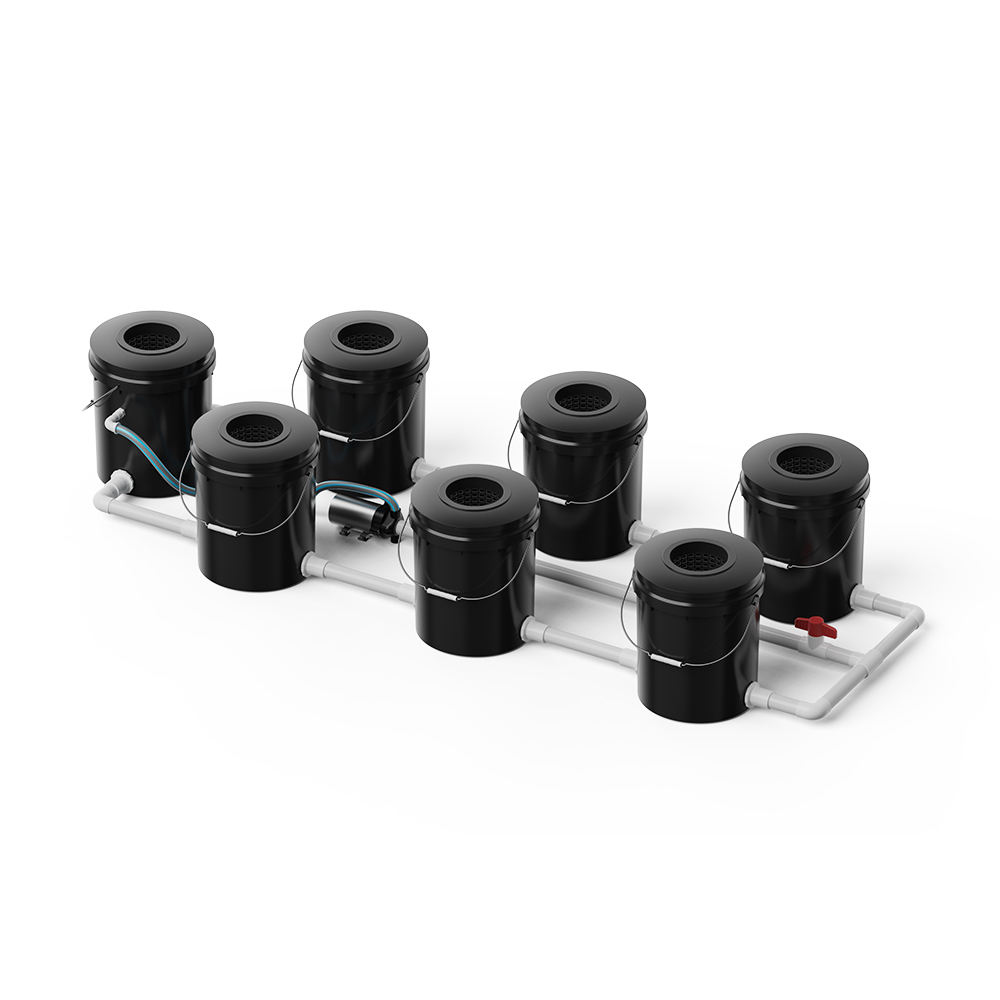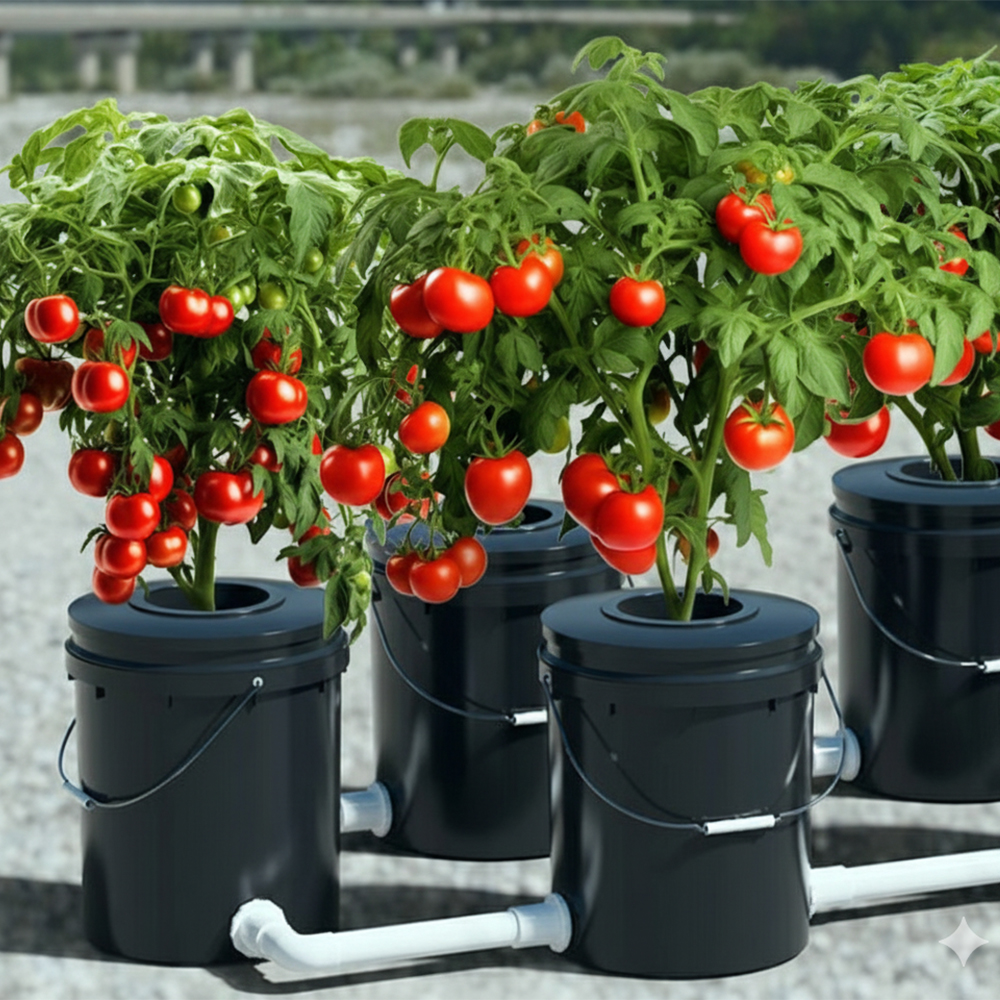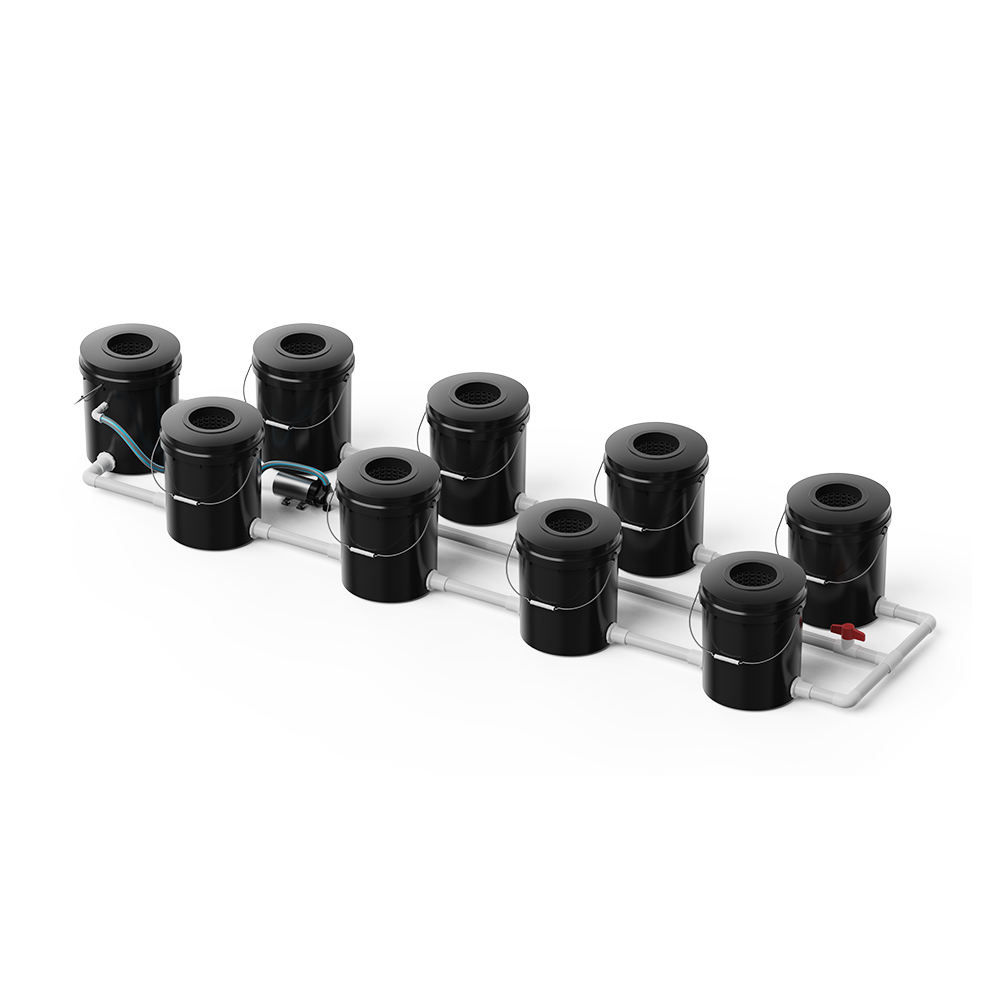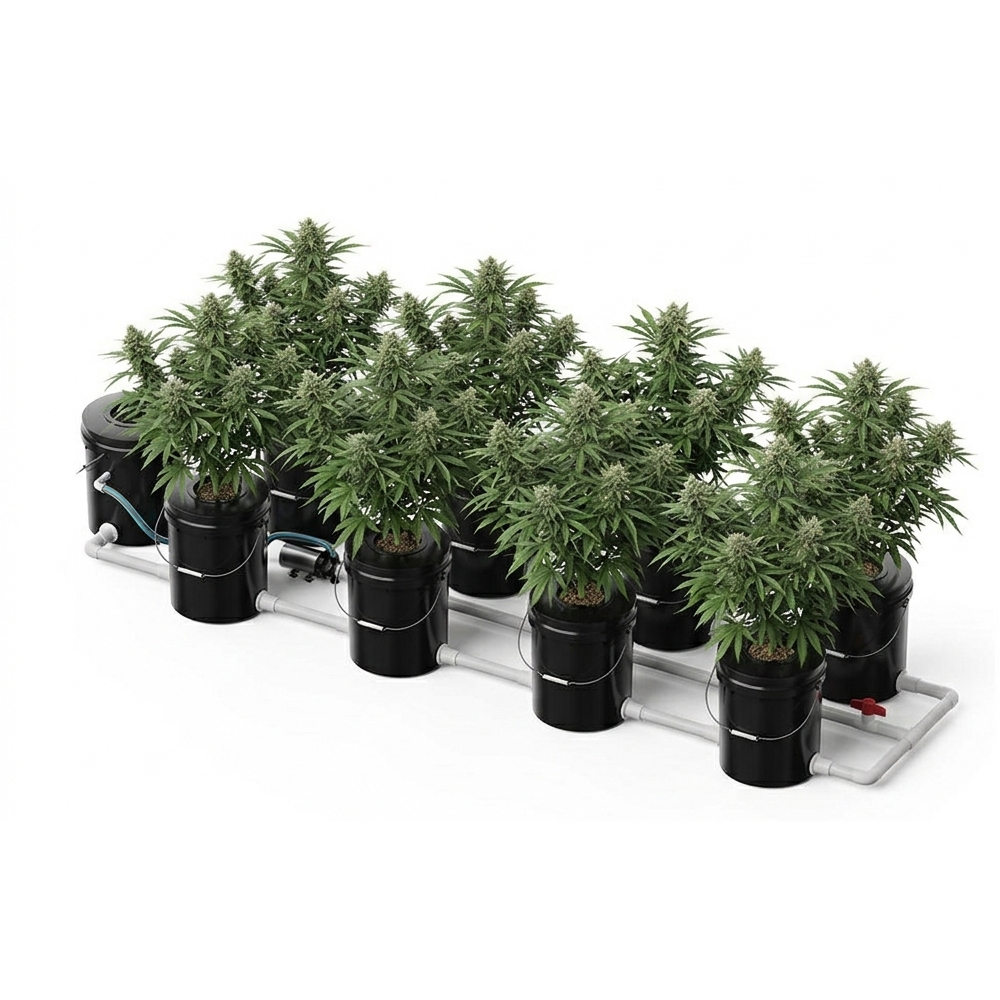
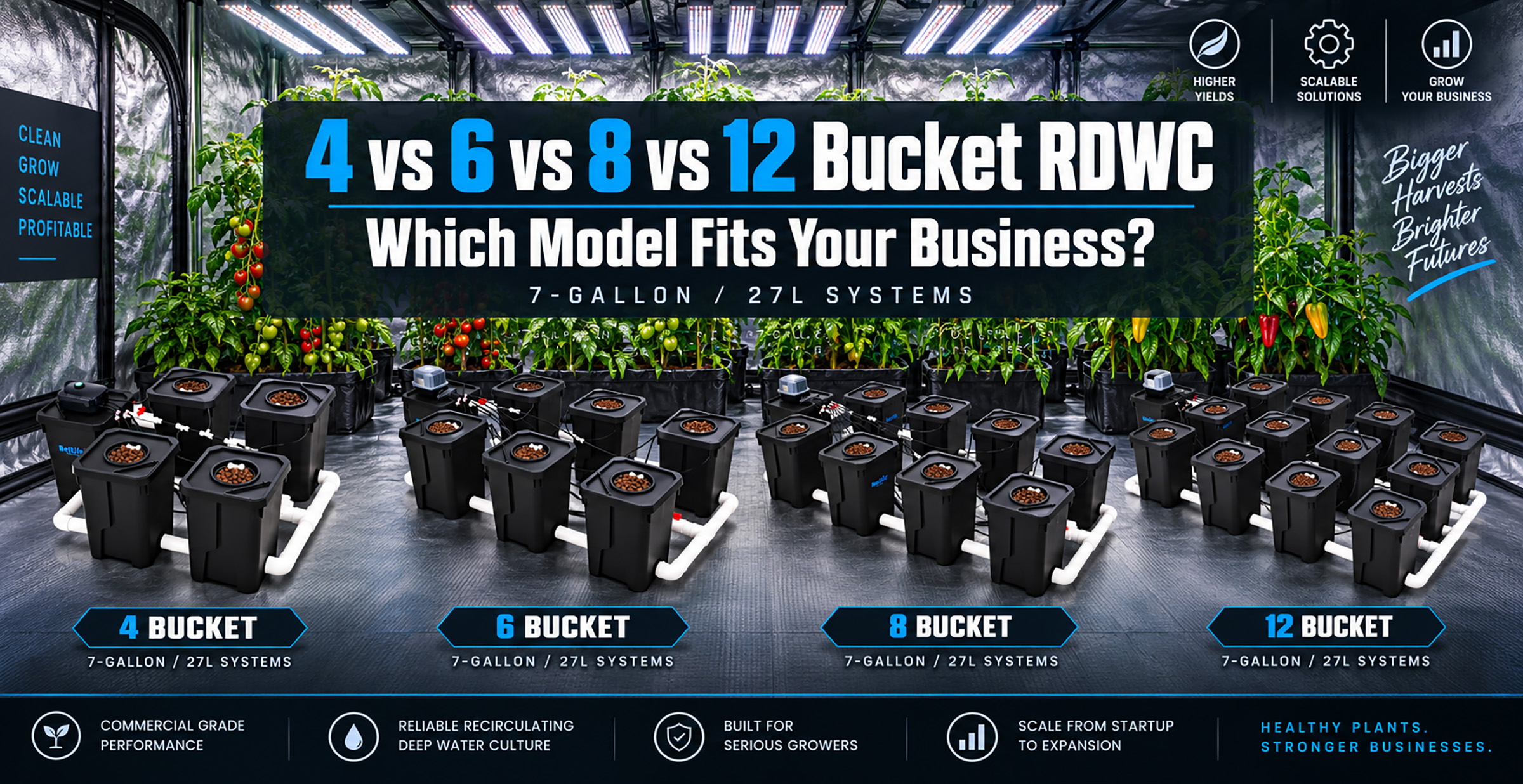
For a grow shop evaluating its first complete RDWC product line, the 6-bucket BLGX-06 and 8-bucket BLGX-08 are useful models to compare first. Choose the 4-bucket BLGX-04 when a compact demonstration or four-site installation is the priority. Shortlist the 12-bucket BLGX-12 when a buyer needs twelve planting sites in one system and has room for its wider layout.
For commercial growers, the decision starts with the planting-site target, usable room dimensions and the number of independently managed nutrient zones. This guide compares BetiLife's four standard 7-Gallon / 27L RDWC systems so you can match a model to a business requirement and request a relevant quote.
By BetiLife | Product specifications and published retail references reviewed
Quick Comparison of 4, 6, 8 and 12 Bucket RDWC Systems
| Model and planting sites | Published system footprint | When to shortlist it |
|---|---|---|
| BLGX-04 4 planting sites |
120 × 90 cm Approx. 4 × 3 ft |
Compact display, evaluation unit or four-site growing zone |
| BLGX-06 6 planting sites |
170 × 90 cm Approx. 5.6 × 3 ft |
Mid-range retail offer or a six-site installation with a shorter layout than BLGX-08 |
| BLGX-08 8 planting sites |
230 × 90 cm Approx. 7.5 × 3 ft |
Eight-site demand, a longer narrow room or a higher-capacity retail demonstration |
| BLGX-12 12 planting sites |
240 × 130 cm Approx. 7.9 × 4.3 ft |
Twelve-site production zone or project sales where a wider system fits |
Each model includes one additional reservoir bucket. The stated 4, 6, 8 or 12 buckets refer to planting sites and exclude that reservoir. All four use the same nominal 7-gallon / approximately 27-liter planting-bucket platform, with food-grade PP buckets and an integrated drip irrigation function. See the BetiLife collection specification chart for the published references.
Business uses in this guide are selection recommendations. Local demand, available space and the current quotation determine which model makes sense for your business.
Why Bucket Count Matters in RDWC System Selection
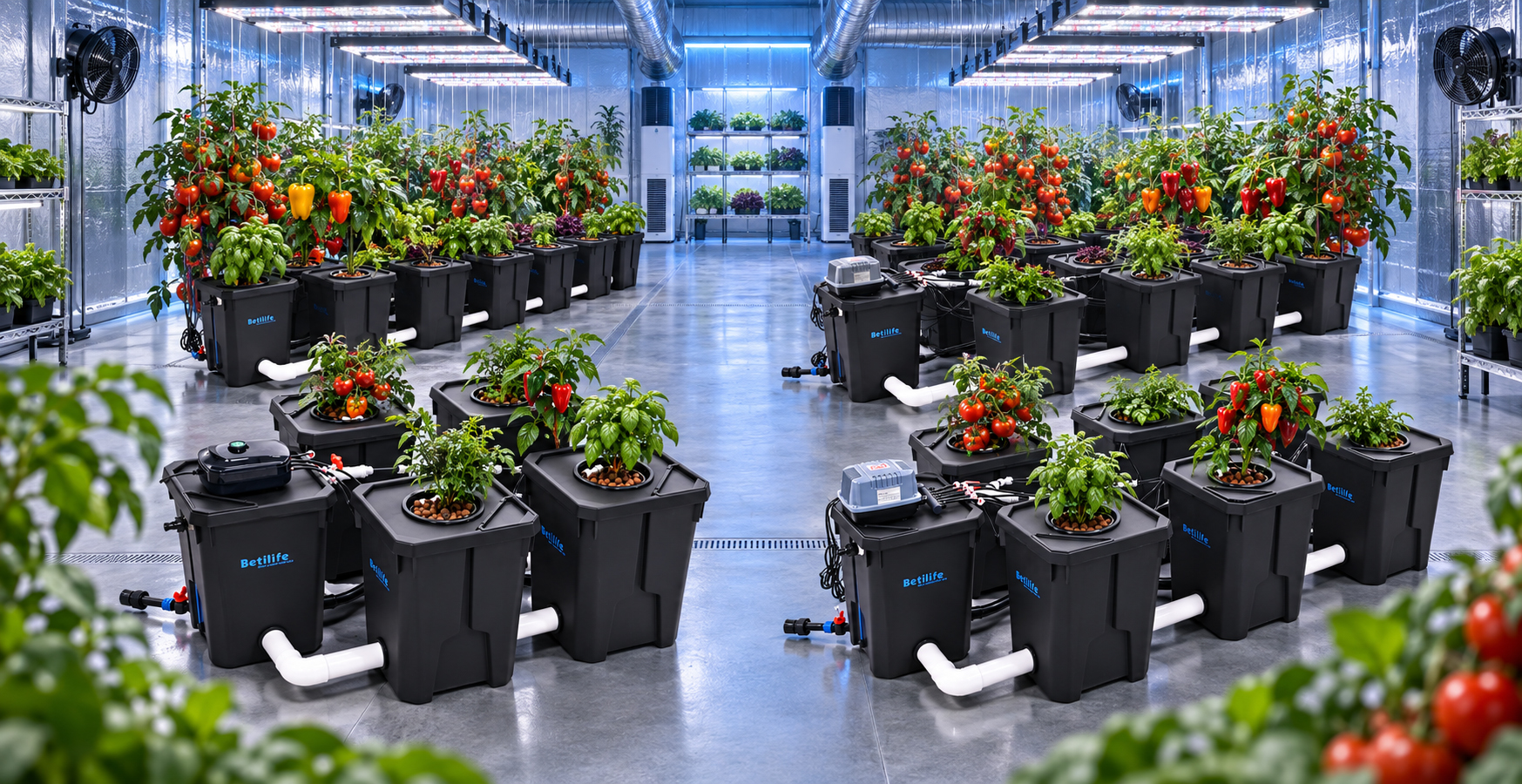
RDWC stands for Recirculating Deep Water Culture. Connected planting buckets share a reservoir and a circulation loop. Increasing the bucket count adds planting sites to that system, which changes its layout, the number of connections to inspect and the amount of equipment a retailer must store or demonstrate.
Keep three measurements separate when comparing models:
- Planting-site count: the number of planting positions in the specified system.
- Bucket capacity: the nominal size of each planting container. The 7-Gallon / 27L label does not describe the operating water volume of the entire system.
- Installation space: the equipment footprint plus the clearance your layout needs for canopy, reservoir access, inspection and cleaning.
For example, twelve planting buckets do not establish a crop yield or a harvest schedule. Crop choice, mature canopy size, lighting and the operating plan still determine how those sites can be used. Likewise, multiplying twelve by 27 liters does not give an approved fill volume. Follow the model's setup instructions for operating water levels.
A complete RDWC kit also needs to be budgeted within the wider growing setup. Confirm the packing list and separately account for any lighting, climate equipment, monitoring, water treatment or cooling required by the project.
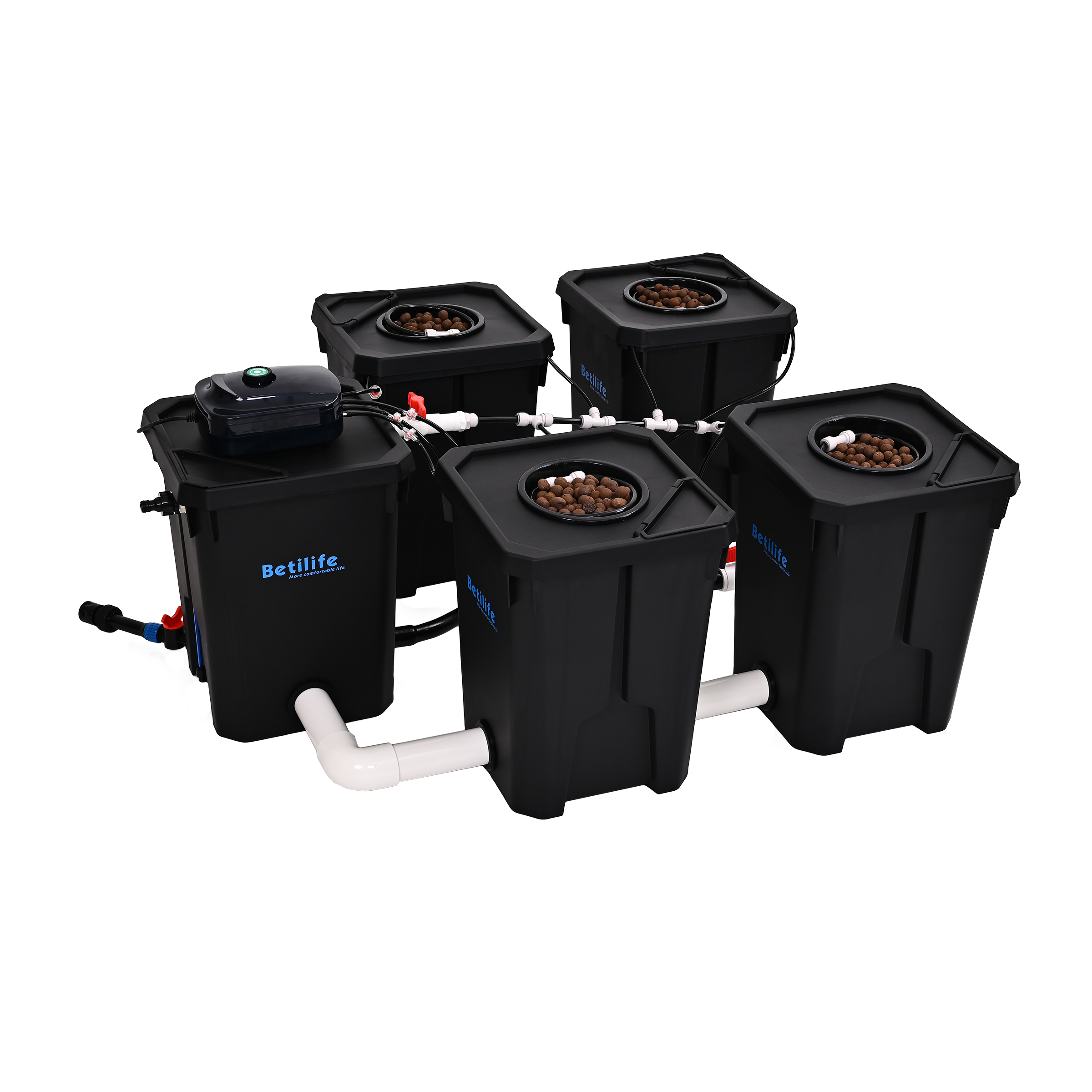
4-Bucket RDWC for Compact Evaluation and Four-Site Projects
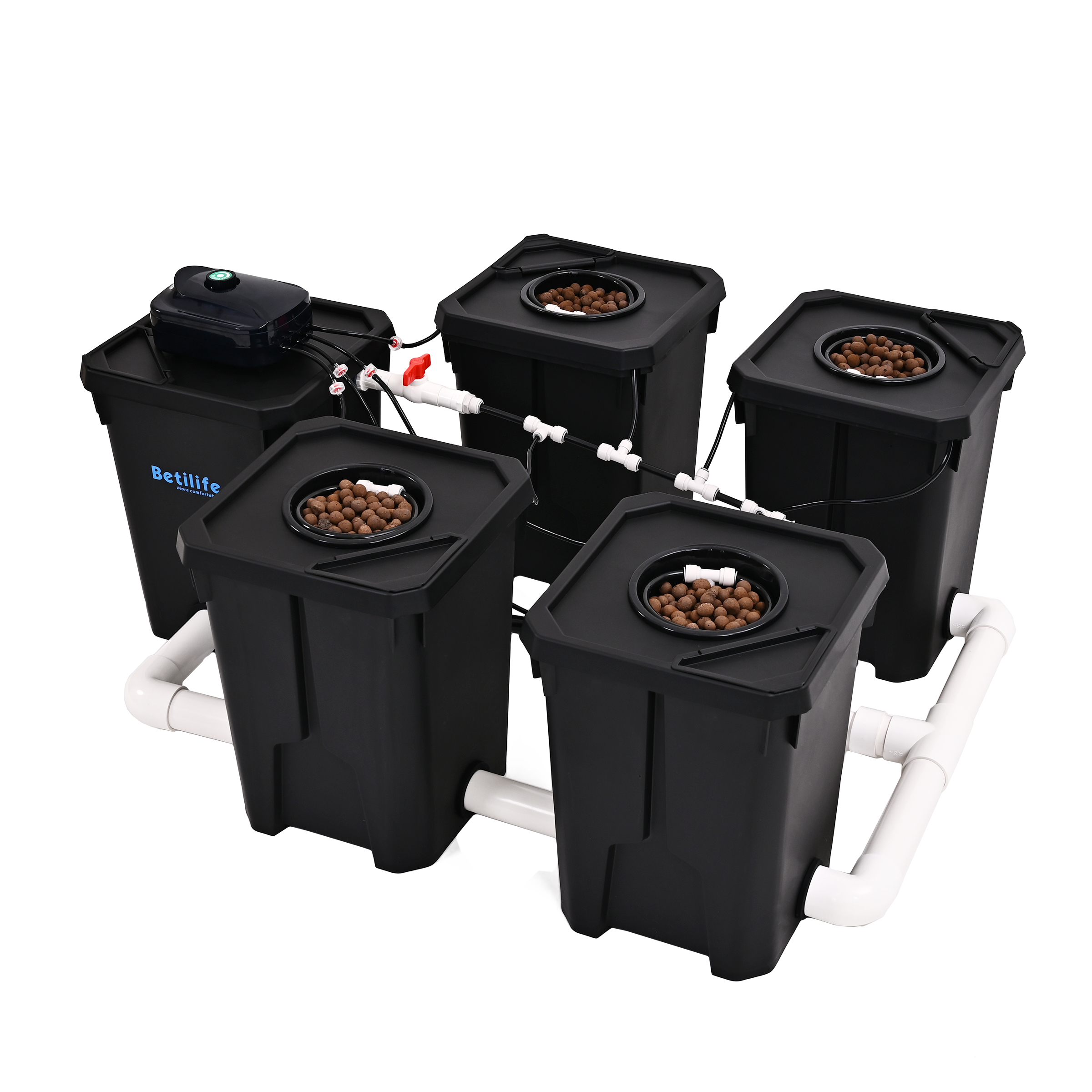
The BLGX-04 is the smallest standard configuration. It is a practical candidate when a grow shop wants to demonstrate assembly and circulation in limited display space, or when a grower has a defined four-site requirement.
It also has the lowest published retail reference price in this four-model line. That can make it useful for an initial product evaluation, provided the small configuration represents the customers you intend to serve. A retailer targeting eight-site installations may learn more by evaluating BLGX-08 directly.
For space planning, a nominal 4 × 4 ft enclosure offers little spare clearance around the equipment. Measure the actual interior and check how staff will reach the reservoir and fittings. A larger area, such as 5 × 5 ft, provides more layout options but still needs an access plan.
Shortlist BLGX-04 when: a compact setup, a four-site zone or a smaller initial equipment purchase matters most. Compare it with BLGX-06 if your expected customers consistently need more planting positions.
View BLGX-04 specifications and product details
6-Bucket RDWC for a Mid-Range Retail Offer

The BLGX-06 adds two planting sites over BLGX-04 while retaining a 90 cm system width. Its position between the four-site and eight-site options makes it a useful candidate for a grow shop's first representative evaluation unit.
Choose it when customers want more capacity than the compact model and have a reason to prefer the shorter 170 cm layout. In a nominal 4 × 8 ft area, the six-site footprint leaves more remaining length than BLGX-08 for arranging service access. The final decision still depends on the interior measurements and mature canopy.
For a retailer, the main question is whether six sites match incoming inquiries. Mid-range positioning alone does not establish a best-selling SKU. Record the model customers request, the room dimensions they provide and the prices they accept before expanding inventory.
Shortlist BLGX-06 when: you need six planting sites, a shorter narrow layout or a mid-range system to evaluate before stocking.
View BLGX-06 specifications and product details
8-Bucket RDWC for Longer Grow Rooms and Eight-Site Demand

The BLGX-08 provides eight planting sites while keeping the same 90 cm width as the smaller models. It is worth evaluating when a retailer serves customers planning longer grow rooms or when a grower needs an eight-site nutrient zone.
The difference from BLGX-06 is concrete: two additional planting sites and 60 cm of additional system length. A showroom choosing between them should consider whether visitors need to see an eight-site configuration and whether the display remains accessible during demonstrations.
A nominal 4 × 8 ft footprint comparison needs care. Eight feet is 243.84 cm, leaving only about 14 cm of total spare length around the published 230 cm system before accounting for the actual enclosure and installation requirements. A 5 × 10 ft or larger area gives more planning flexibility.
Shortlist BLGX-08 when: eight sites fit the business requirement and the longer layout preserves access. Its published retail reference also gives it the lowest equipment price per planting site in the comparison below; a wholesale quotation may produce a different result.
View BLGX-08 specifications and product details
12-Bucket RDWC for Higher-Capacity Buyers

The BLGX-12 is the highest-capacity standard model in this line. It is a candidate for a twelve-site production zone, a larger showroom installation or a retailer quoting a defined commercial project.
Compared with BLGX-08, it adds four sites and increases the published footprint by 10 cm in length and 40 cm in width. The width matters: 130 cm exceeds the nominal width of a four-foot space. The standard BLGX-12 layout therefore does not fit a 4 × 8 ft tent.
BetiLife lists larger spaces such as 5 × 10, 5 × 12 and 8 × 8 ft as planning references. Review the service route around the complete installation before ordering. For dealers, its two-box packaging also needs to be reflected in storage, delivery and receiving instructions.
Shortlist BLGX-12 when: twelve sites belong in one nutrient circuit and the room accommodates the wider layout. If the project needs independently managed groups, compare multiple complete systems as well.
View BLGX-12 specifications and product details
Compare Price per System and Price per Planting Site
The following figures use the retail reference prices published in BetiLife's collection chart, reviewed September 14, 2026. They illustrate the product price steps and are not wholesale, evaluation-unit or delivered project quotations. Confirm current pricing and any shipping, duties, taxes and other charges before purchasing.
| Model | Retail reference per system | Reference price per planting site |
|---|---|---|
| BLGX-04 | $599 | $149.75 |
| BLGX-06 | $799 | $133.17 |
| BLGX-08 | $949 | $118.63 |
| BLGX-12 | $1,499 | $124.92 |
Calculation: published system reference price ÷ planting-site count, rounded to the nearest cent. The separate reservoir is excluded from the site count.
At these references, moving from BLGX-06 to BLGX-08 adds $150 for two more sites. Moving from BLGX-08 to BLGX-12 adds $550 for four more sites and a different layout. BLGX-08 has the lowest reference price per site, while BLGX-04 has the lowest initial system price. Those are different buying priorities.
For resale, compare the selling price you expect to achieve with the actual quoted acquisition cost, applicable freight, transaction fees and the cost of handling and support. Do not infer a dealer margin from the retail table. Request a quote for the specific model and quantity you plan to evaluate or stock.
Which RDWC Model Is Best for Grow Shops and Distributors?
Start with the gap in your existing range. A store selling lights, nutrients and individual hydroponic components may want a complete RDWC option. A store already carrying complete systems needs to identify which planting-site count, footprint or price point its current assortment does not cover.
For a retailer with enough display space, compare BLGX-06 and BLGX-08 as initial evaluation candidates. The six-site model has a lower published system reference and shorter layout. The eight-site model lets staff demonstrate more planting positions within the same width. Choose the one that best represents the inquiries you expect to handle.
A compact shop can evaluate BLGX-04 instead. A distributor already receiving twelve-site project inquiries may reasonably begin with BLGX-12. The useful evaluation unit is the one that answers your next commercial question.
- Choose one representative model and request its current specifications, packing list and evaluation quotation.
- Check the received components, assembly instructions, circulation, access and support process using the supplied manual.
- Prepare a product listing with the correct planting-site count, reservoir count, footprint and included components.
- Use actual inquiries and evaluation results to select an opening order. Discuss a mixed-model assortment if demand supports it.
A new retailer can start with a narrow assortment and expand after learning which model customers request. An established distributor can map the four models to compact, mid-range, eight-site and project demand, then set quantities from its own sales evidence.
For supplier due diligence, read what U.S. grow shops should look for in an RDWC wholesale supplier. For channel discussions, visit BetiLife's RDWC suppliers and wholesalers page.
Which RDWC Model Is Best for Commercial Growers?
A grower's first order should be sized around a production requirement. Give the supplier your target planting-site count and usable room dimensions first, then explain the crop, spacing and whether groups must use separate nutrient solutions or operating schedules.
For a defined six-site zone, BLGX-06 may be sufficient. An eight-site zone in a longer narrow area points toward BLGX-08. A twelve-site zone in a wider room points toward BLGX-12. The total floor area alone is insufficient: the shape of the room and access to each bucket can change the choice.
Example: Comparing Three Ways to Plan 24 Planting Sites
The following is an illustrative equipment comparison for separate complete systems. It is not a proposed plumbing connection between systems or a finished room design. All configurations provide 24 nominal planting sites.
| Configuration | Independent systems and reservoirs | Combined retail reference |
|---|---|---|
| 2 × BLGX-12 | 2 systems 2 reservoirs |
$2,998 |
| 3 × BLGX-08 | 3 systems 3 reservoirs |
$2,847 |
| 4 × BLGX-06 | 4 systems 4 reservoirs |
$3,196 |
Three BLGX-08 units have the lowest combined retail reference in this example, but involve three reservoirs and their associated equipment and service tasks. Two BLGX-12 units have fewer separate systems and wider individual footprints. Four BLGX-06 units provide four separate six-site groups. Independent systems can be useful when groups need different nutrient management or staggered cleaning.
Compare these options on a scaled room plan and request the actual project quote. Delivered cost, access, utilities and daily work can outweigh the difference in reference equipment prices.
For a phased project, describe the first installation as Phase 1 and state the later planting-site target. More than twelve sites can be discussed through multiple standard systems or a project-specific configuration. Adding buckets to an existing loop requires review of the layout, circulation, aeration and compatible components.
See the commercial RDWC grow-room selection guide for a fuller room-planning checklist.
Include Packaging and Support in the Model Decision
System footprint is only one space requirement. Grow shops also need room for packaged inventory, while project buyers need a clear receiving route. BetiLife publishes the following packaging references in its standard model chart.
| Model | Packaging reference | Net weight reference |
|---|---|---|
| BLGX-04 | 80 × 33.5 × 33.5 cm | 16 kg |
| BLGX-06 | 98 × 33.5 × 33.5 cm | 21 kg |
| BLGX-08 | 140 × 33.5 × 33.5 cm | 26 kg |
| BLGX-12 | Box A: 120 × 33.5 × 33.5 cm Box B: 85 × 33.5 × 33.5 cm |
Box A: 18 kg Box B: 23 kg |
Net weight is not gross shipping weight or chargeable freight weight. Request the current packing list, gross weights and any pallet details for the order. For BLGX-12, make sure both boxes are tracked and received as one complete system.
The published standard models share a 60W water-pump reference rated at 3,500 L/h, while their air-pump configurations differ. Confirm the model-specific components, U.S. voltage, frequency and plug in the quotation. A pump's rated flow is a component reference; it does not establish the measured flow or dissolved oxygen at every planting site after installation.
Ask how installation questions, compatible replacement parts and warranty claims will be handled for the model you choose. BetiLife describes setup guidance, troubleshooting, replacement-parts support and a one-year limited warranty for eligible components on its B2B website. Review the applicable warranty policy and order terms for coverage and the claim process.
Why BetiLife Uses a Clear 4 / 6 / 8 / 12 Bucket Structure
The four standard models give buyers a consistent starting point: the same nominal bucket-capacity platform with different planting-site counts, footprints and purchasing commitments. A retailer can explain the progression using dimensions and customer requirements. A project buyer can compare system combinations before requesting a layout and quote.
The structure also makes inquiries more specific. “One BLGX-06 for dealer evaluation” and “24 sites for Phase 1 in a room of these dimensions” give BetiLife enough direction to begin the relevant discussion. Once the model or project scope is clear, the team can review quantities, support needs and DDP or FOB quotation options.
A shared platform does not establish that every pump, fitting or spare part is interchangeable. Confirm part compatibility for the model and production version, especially when planning mixed inventory or later expansion.
Frequently Asked Questions About RDWC Bucket Counts
Does a 4-bucket RDWC system include the reservoir in the bucket count?
For BetiLife BLGX-04, four buckets means four planting buckets plus one separate reservoir. The six-, eight- and twelve-bucket models follow the same counting convention.
Is 7-Gallon / 27L the capacity of the whole system?
No. It describes the nominal planting-bucket capacity, approximately 27 liters per bucket. Operating fill volume depends on the installed system and specified water level. It should not be calculated by treating every bucket as filled to its nominal capacity.
Should a grow shop evaluate a 6-bucket or 8-bucket RDWC system first?
Choose BLGX-06 if six-site demand, shorter display length or a lower initial reference price is the priority. Choose BLGX-08 if customers need eight sites and you can accommodate its 230 cm length. Request the current evaluation quotation for the model that represents your intended customers.
Which model has the lowest price per planting site?
Using the published retail references in this guide, BLGX-08 has the lowest equipment price per site at approximately $118.63. This is a retail-reference calculation. Wholesale pricing, delivered charges and operating requirements can change the comparison.
Will an 8-bucket RDWC system fit a 4 × 8 grow tent?
The published BLGX-08 footprint of 230 × 90 cm is within nominal 4 × 8 ft dimensions. Available length is tight, so check the actual interior, reservoir position, fittings, canopy and service access before selecting it. Dimensional fit alone does not confirm a workable installation.
Can the 12-bucket model fit a 4 × 8 grow tent?
The standard BLGX-12 layout is 240 × 130 cm. Its 130 cm width exceeds four feet, so it is not suitable for that nominal grow tent footprint. Review a wider layout with sufficient access.
Can I expand a 4-bucket system into an 8- or 12-bucket system?
Discuss the proposed change with BetiLife before buying expansion components. The layout, pump configuration, aeration and compatible parts need review. For some projects, another complete independent system may better match the intended growing zones.
Can a business order mixed models or more than twelve planting sites?
Mixed-model orders and project-specific quantities can be discussed. Send the quantity of each model for resale, or the total planting-site target and room dimensions for cultivation. The final configuration, availability, terms and freight require a quotation.
Request the RDWC Model That Fits Your Business
For grow shops and distributors: tell us whether RDWC is a new category for your business and which model interests you. State whether you want a representative evaluation unit or an opening inventory quote, and include your U.S. delivery ZIP code.
Ask About a Dealer Evaluation Model
For commercial growers: send your Phase 1 planting-site target, usable room length and width, crop and delivery ZIP code. Mention any need for separate nutrient zones so the recommendation can account for both equipment cost and daily management.
Request a Project Model Recommendation
Contact JianHong Tan, Founder & Sales General Manager, at jianhongtan@betilife.com, message BetiLife on WhatsApp, or use the BetiLife contact page.
Specification and pricing source: BetiLife 7-Gallon / 27L Commercial RDWC Collection, with individual product pages linked throughout. Business-fit recommendations and the cost calculations are editorial analysis based on those published references. Confirm the latest specification sheet, packing list and written quotation for the order.