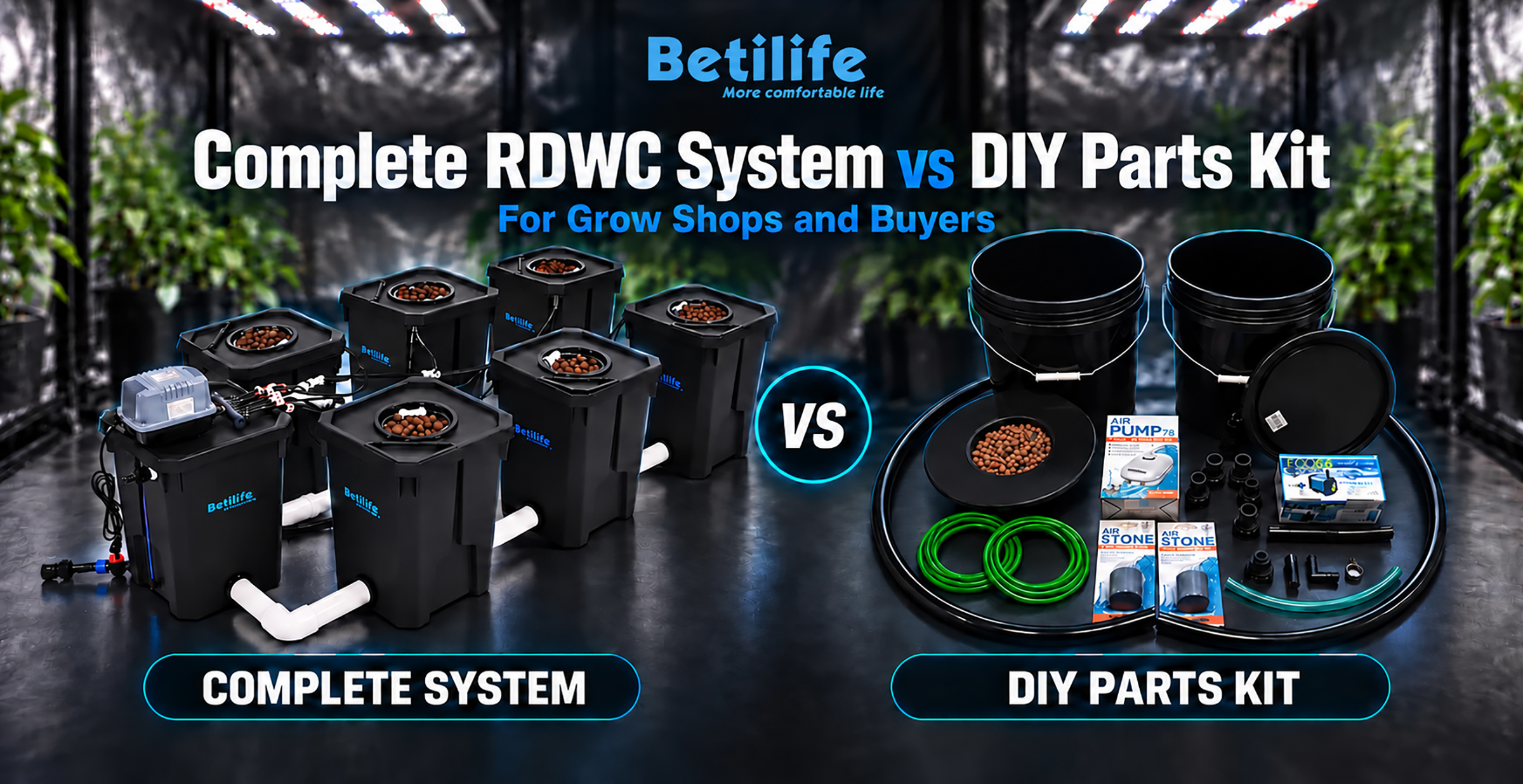
A complete RDWC system is usually the better starting point for a grow shop that wants a defined product to sell and support, or a commercial buyer that wants a documented equipment package. A DIY parts kit can be a better fit when the buyer has the skills and time to specify, assemble and validate a custom system, particularly when suitable equipment is already available.
The deciding question is who will take responsibility for component compatibility, installation instructions, commissioning and support. A complete system should make those responsibilities easier to identify. A DIY purchase may leave more of them with the buyer, retailer or installer.
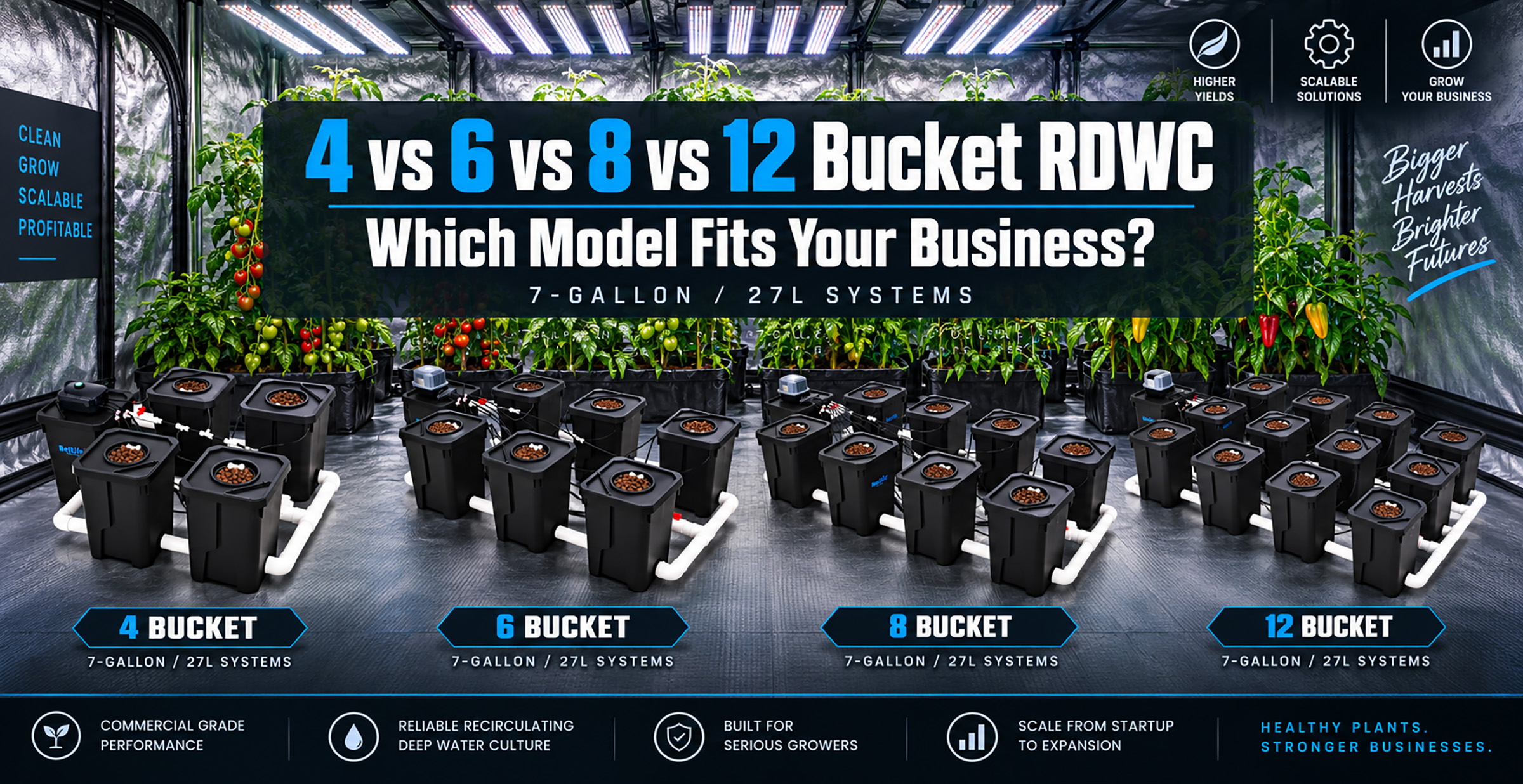
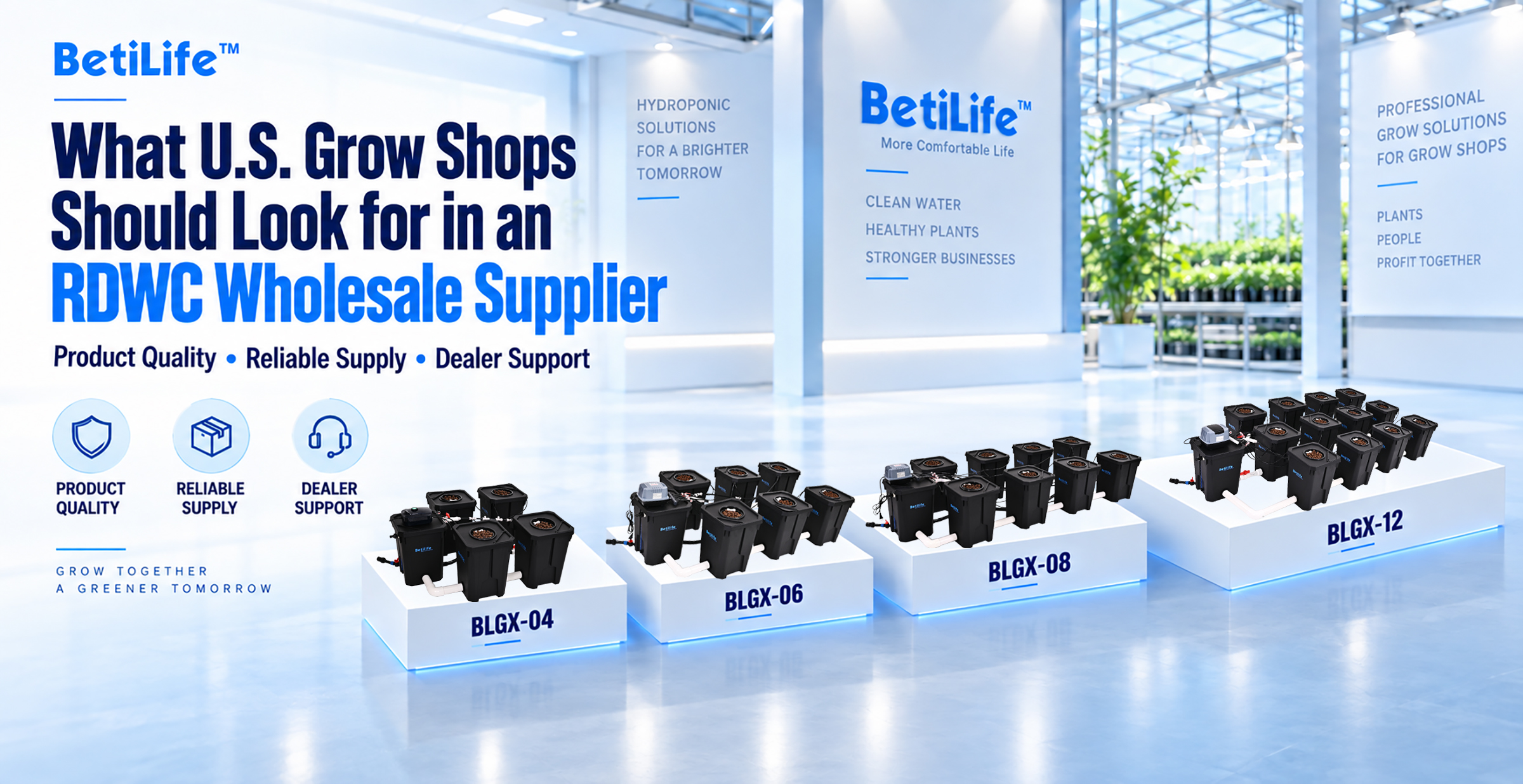
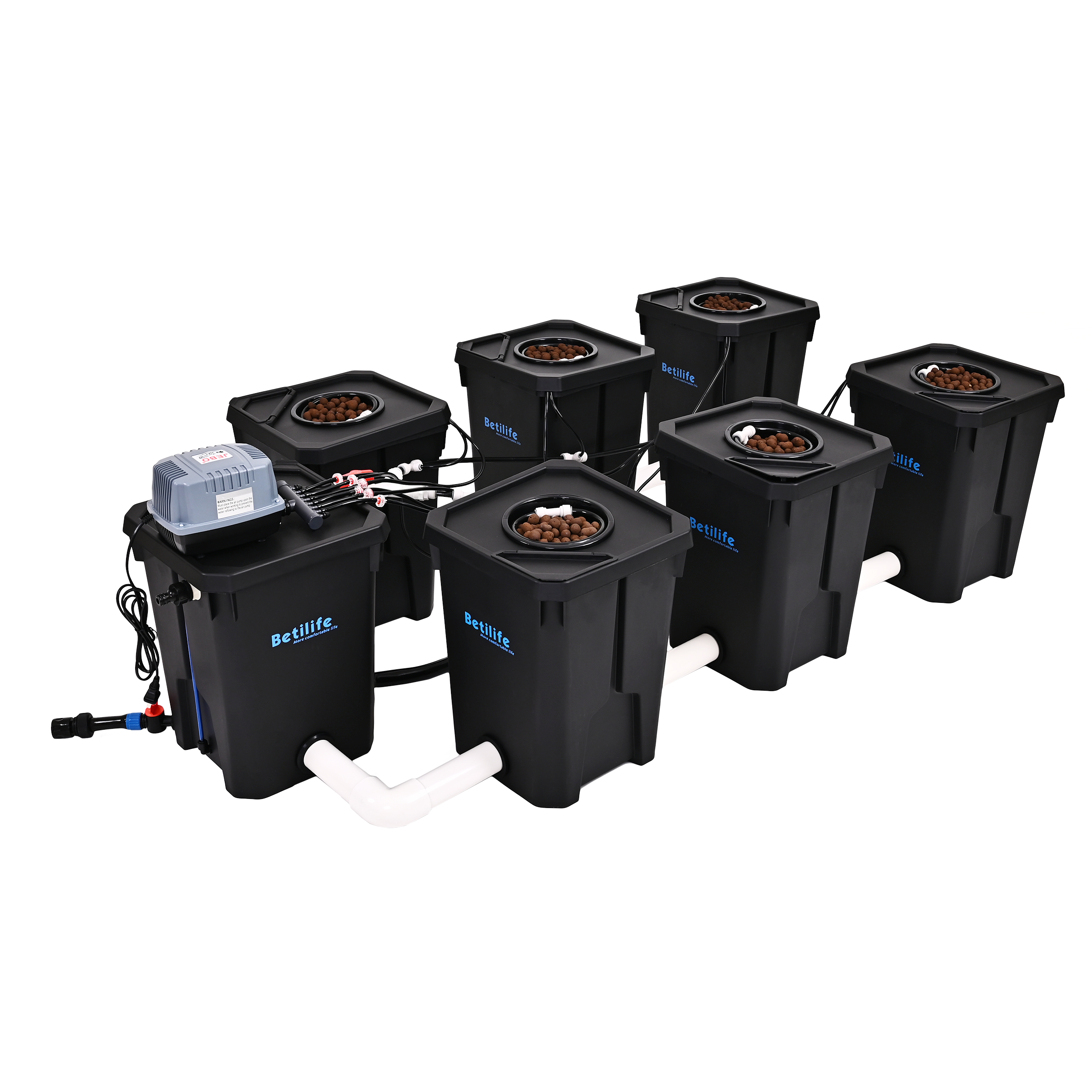
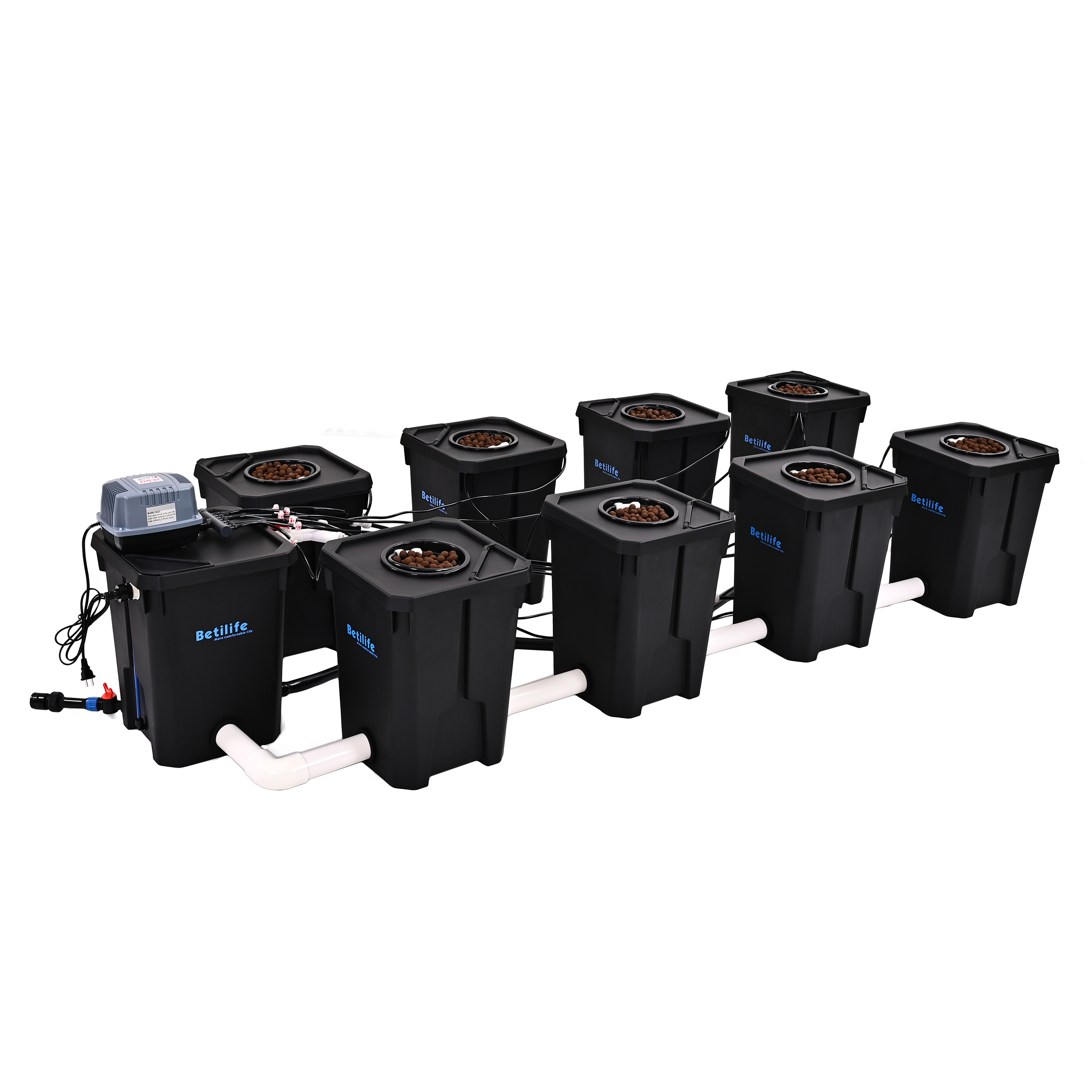
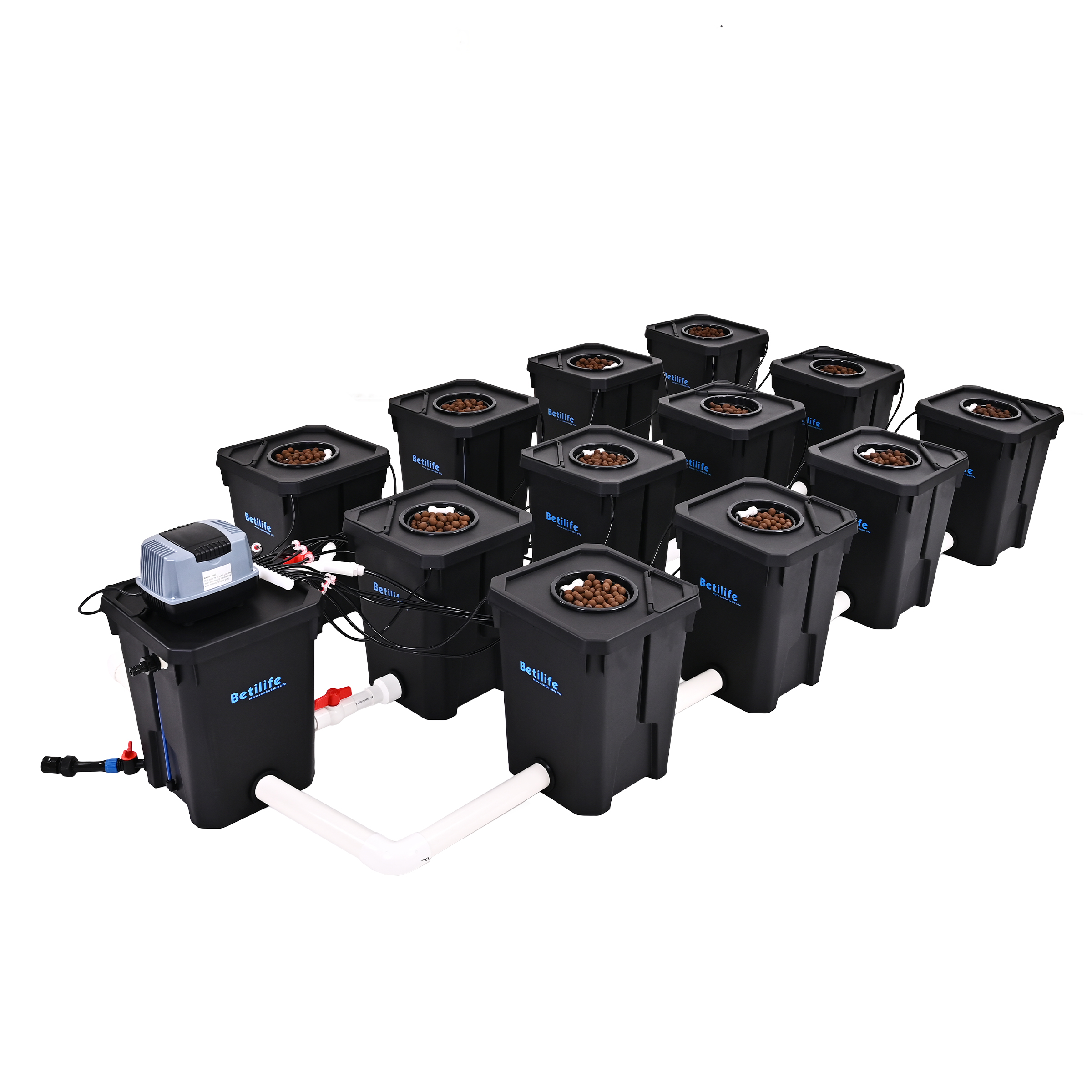
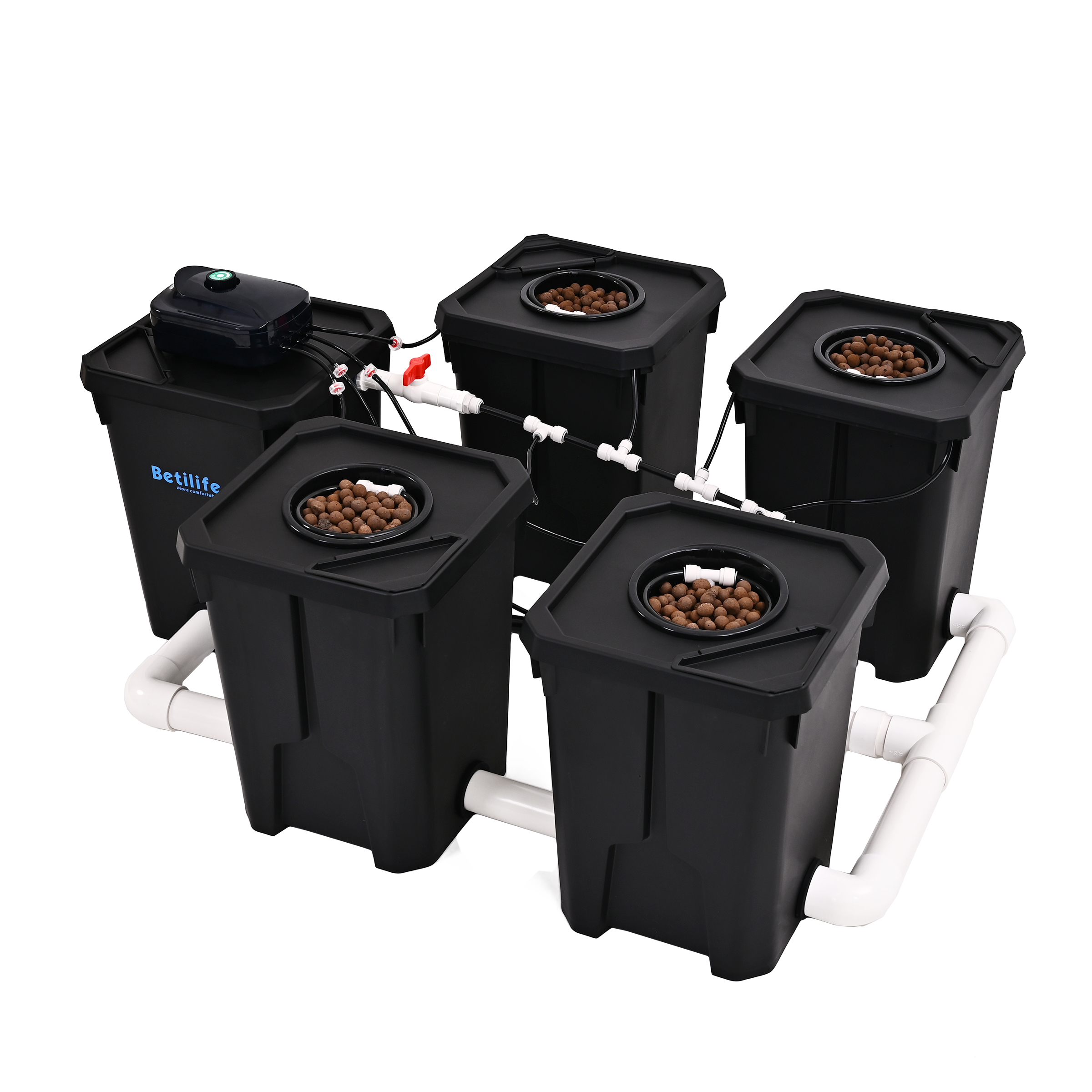
This guide compares both approaches for U.S. grow shops, hydroponic retailers, distributors and commercial growers. It also shows how BetiLife's BLGX-04, BLGX-06, BLGX-08 and BLGX-12 fit into a complete 7-Gallon / 27L RDWC product line.
By BetiLife | Product and support references reviewed
Looking for a complete RDWC system line? Explore BetiLife's 4-, 6-, 8- and 12-site models or request a quotation for your business.
What Is a Complete RDWC System?
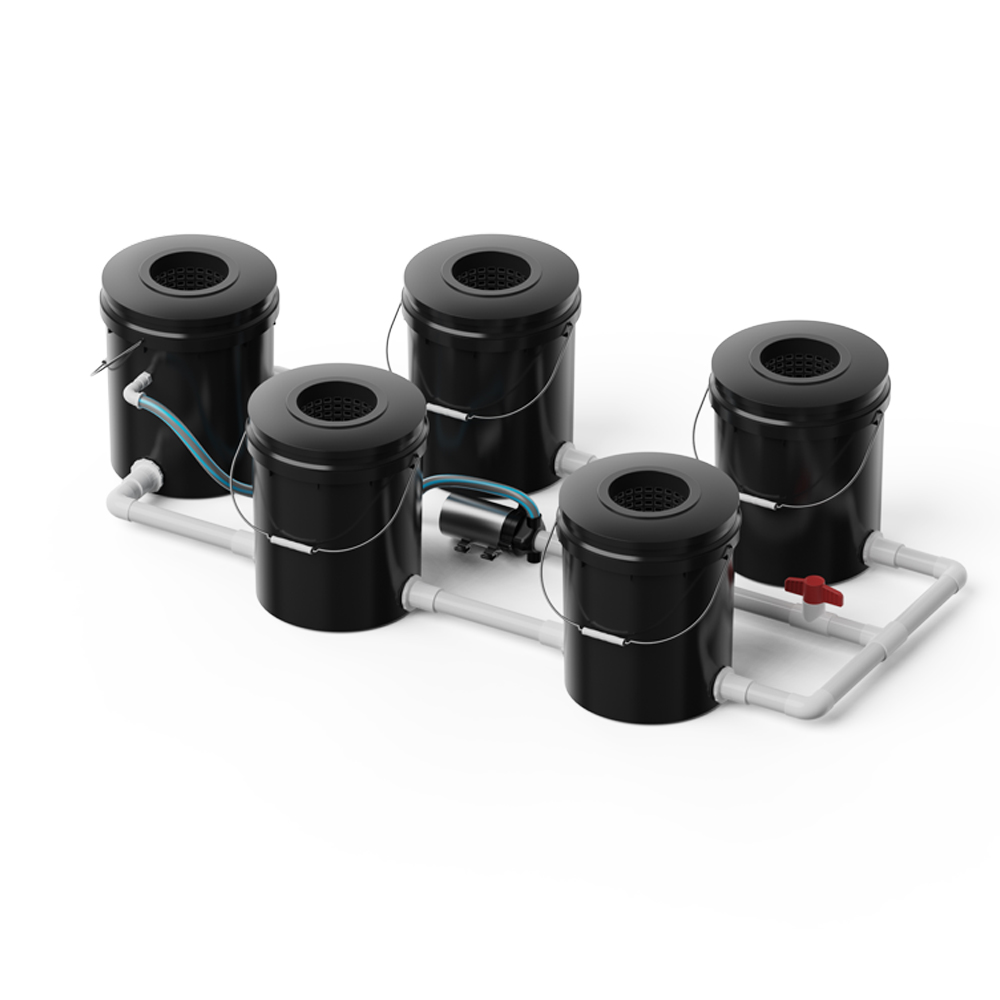
RDWC means Recirculating Deep Water Culture. Planting containers are connected to a circulation system and a shared reservoir. The equipment moves nutrient solution through the connected arrangement, while the specified aeration equipment supplies air to the root-zone solution.
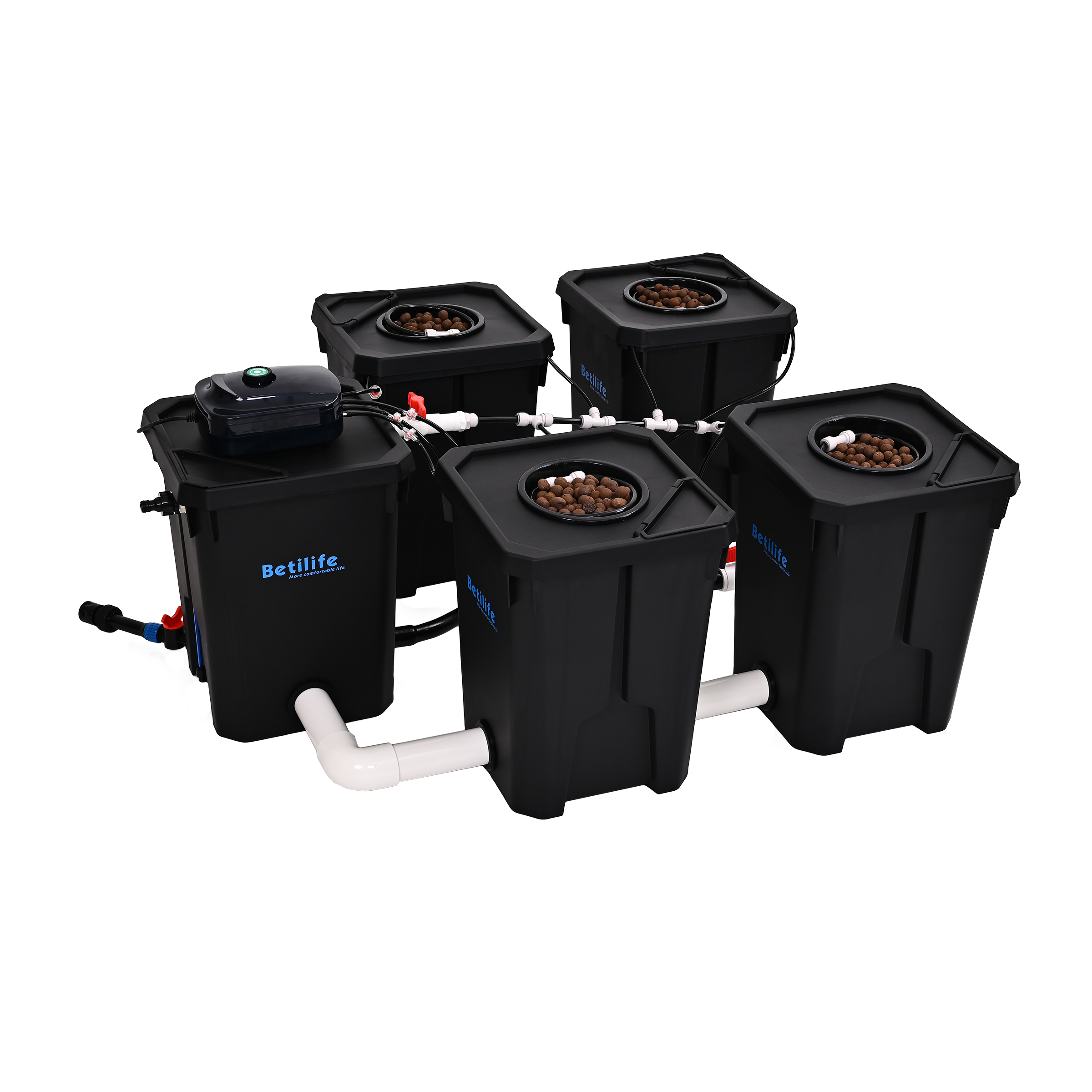
For purchasing purposes, a complete RDWC system is a defined combination of planting containers, reservoir, circulation components, aeration components and associated hardware sold for a specified layout. The supplier should identify the included parts, their quantities and the instructions needed to assemble and operate that configuration.
Complete does not necessarily mean preassembled. A system may arrive packed as separate buckets, pipes, pumps and accessories for transport. The buyer still needs to unpack it, follow the assembly procedure, check connections and test it before introducing plants.
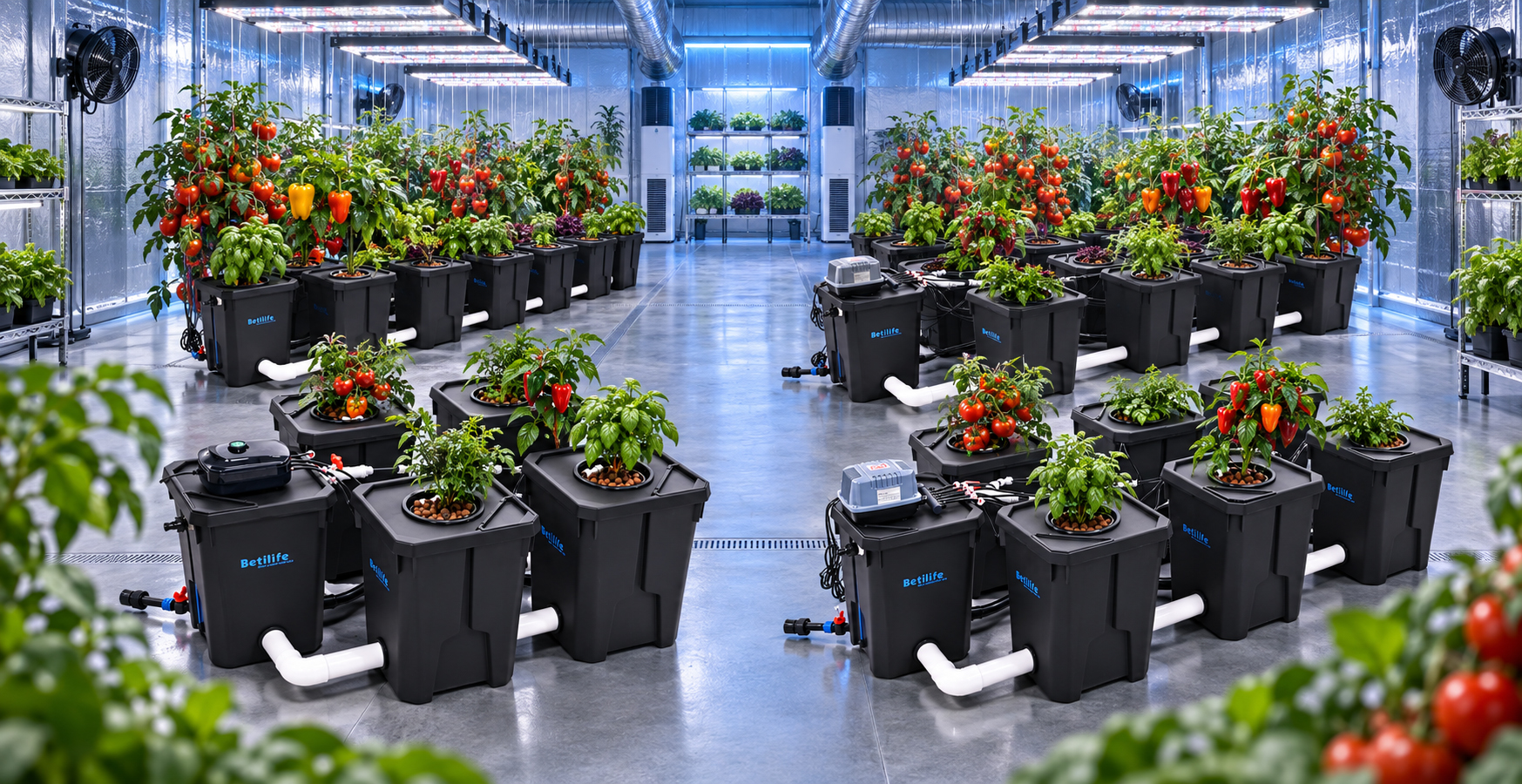
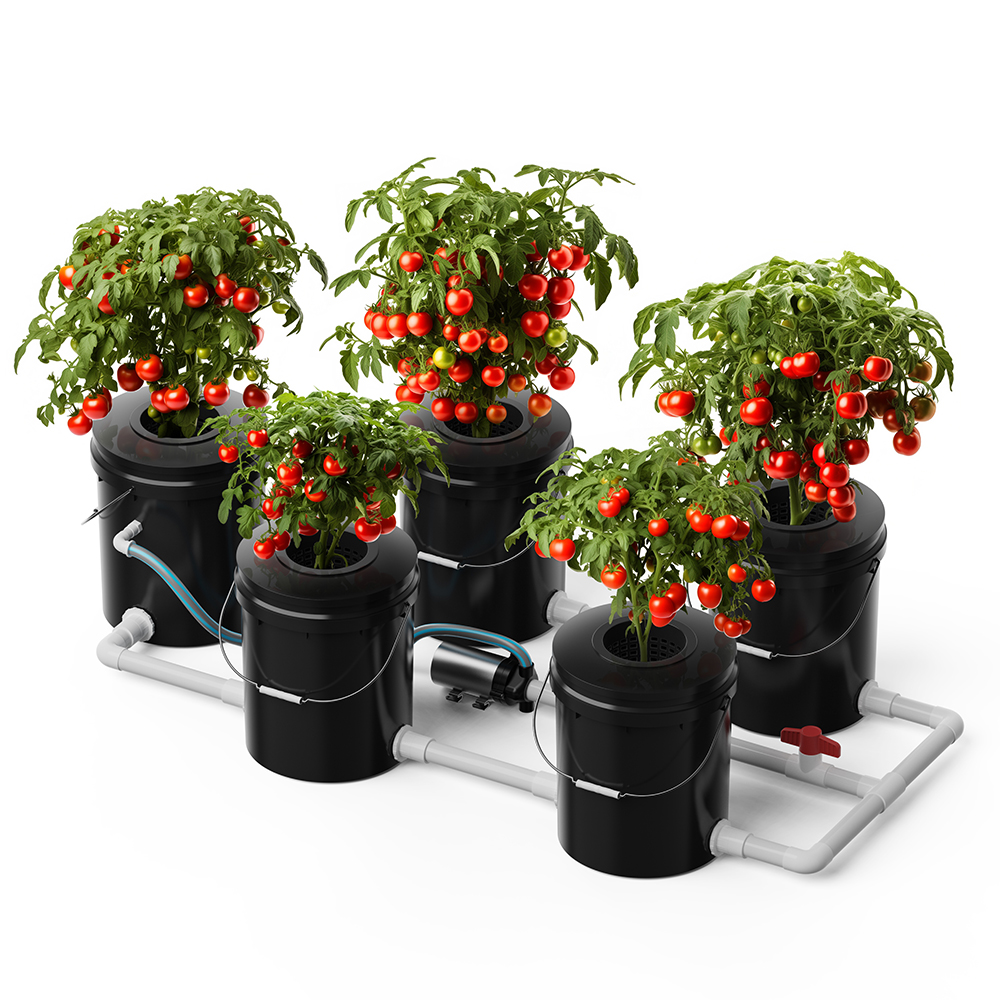
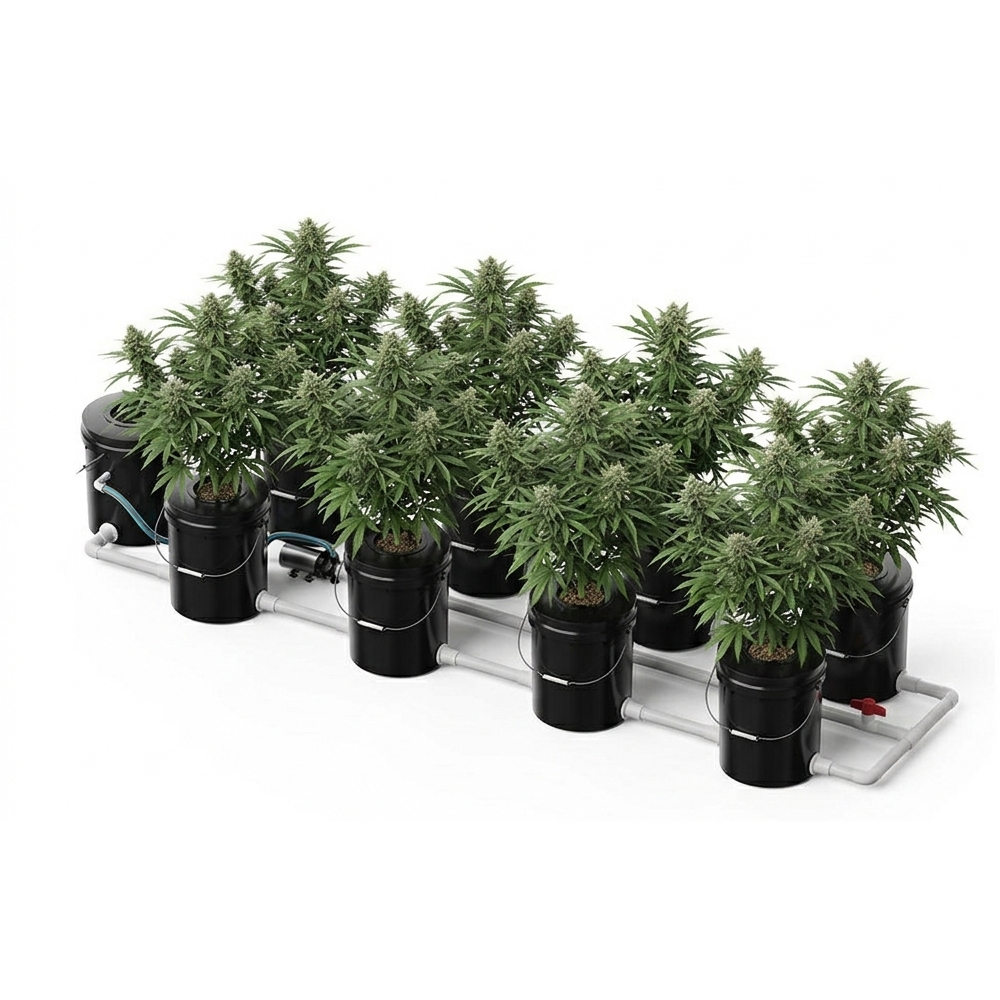
It also does not automatically mean a complete grow room. Lighting, ventilation, environmental controls, water treatment, a chiller, meters, nutrients and plant material should only be treated as included when they appear in the quotation and packing list. An assembled product photograph is not a substitute for that list.

What Is a DIY RDWC Parts Kit?
A DIY RDWC parts kit supplies components for a buyer to build or modify a system. The scope varies considerably. One kit might provide matched plumbing and instructions while requiring locally sourced buckets and pumps. Another might include nearly all the hardware but leave the buyer to determine spacing, fabrication and final installation.
There are also buyers who assemble their own list of parts from several suppliers. That approach offers freedom to select components individually, but someone must confirm that the combined design works.
The words kit and system are not reliable completeness standards. A well-documented builder's kit can be more useful than a poorly specified product labeled “complete.” Equally, a complete system can require do-it-yourself assembly. Compare what is supplied and who supports the configuration rather than deciding from the product name.
DIY is most attractive when customization or reuse has a clear business value and the buyer can carry the design and validation work. A small price difference alone may not justify taking on that work.
Key Differences That Matter to Grow Shops and Commercial Buyers
| Buying factor | Complete RDWC system | DIY parts kit or separate components |
|---|---|---|
| Installation work | A specified layout and assembly process can reduce design decisions. Installation and testing remain necessary. | May add component sourcing, drilling, pipe preparation or layout design, depending on kit scope. |
| Product consistency | A model code and controlled parts list provide a reference for repeat orders. | Consistency depends on the builder's parts records and control of substitutions. |
| Retail readiness | A defined package is easier to describe when images, specifications and instructions are available. | The retailer must explain the included parts, missing items and skills required. |
| Support questions | Staff can troubleshoot against a known configuration if the supplier supports it. | Questions may involve the kit, locally purchased parts and the customer's design choices. |
| Margin calculation | Compare the quoted system cost with the selling price and handling and support expenses. | Include time spent selecting, bundling and explaining parts, plus any fabrication or installation service. |
| Customization | Changes should be checked against the supported model configuration. | Offers greater design freedom where the builder can validate the altered system. |
| Warranty and responsibility | One supplier may coordinate product support, subject to written coverage and exclusions. | Individual parts may have warranties, while integration problems remain the builder's responsibility. |
| Expansion | Repeat models or an approved revised configuration can form the expansion plan. | Changes require the builder to recheck the design, component capacity and service access. |
These are decision criteria, not measured failure rates or installation-time claims. A complete product with poor documentation can still consume substantial labor. An experienced team with a proven DIY design may install its next system efficiently.
Compare the Component Scope Before Comparing Prices
Request a bill of materials, meaning an itemized component list, for each offer. Align the planting-site count, bucket capacity and intended layout first. Then identify what each supplier includes and what the buyer must provide.
| Component group | What to confirm | Why the detail matters |
|---|---|---|
| Planting buckets and lids | Quantity, nominal capacity, material, openings and any preparation required | A bucket count alone does not identify a usable planting module. |
| Reservoir | Quantity, layout position, connections and access | Confirm whether it is additional to the advertised planting buckets. |
| Plant supports | Net pots or baskets, their size and quantity, and whether growing media are included | Items visible in a product photograph may be presentation accessories. |
| Circulation plumbing | Pipes or hoses, fittings, valves, seals, dimensions and connection method | Missing or incompatible connections can hold up installation. |
| Water pump | Model, rating, connections, electrical configuration and installation instructions | The pump must be assessed with the intended circulation path. |
| Aeration | Air pump, air lines, distribution components and diffusers specified for the model | A circulation-pump listing does not describe the aeration package. |
| Top-feed function | Whether included, supplied components and operating instructions | A feature name should correspond to an identifiable set of parts. |
| Setup and service materials | Manual, layout drawing, spare-part identification and support contact | Documentation is part of a product that can be installed and supported repeatedly. |
This checklist describes what to verify; it is not a guaranteed packing list for every complete kit or every BetiLife order. Record agreed inclusions in the quotation and use the final packing list for receiving.
Check Compatibility at the Connections
For a DIY build, identify the actual pipe or hose dimensions, fitting type, seal arrangement and bucket openings. A nominal size printed on two components does not by itself confirm that they connect correctly. Check metric and U.S. sizing conventions and thread types before placing separate orders.
With a complete system, ask how the supplied fittings and seals are assembled and how replacements are identified. Confirm whether any cutting, drilling or additional tools are required. Treat an unapproved component substitution as a configuration change that needs review.
Separate Component Ratings From Installed Performance
A water pump's rated flow is a specification for that component. The installed circulation path, restrictions and elevation affect the actual result. Likewise, visible bubbles do not measure dissolved oxygen throughout a growing system. Ask for the supported layout and evaluate the installed system under the supplier's instructions.
For U.S. installations, confirm voltage, frequency and plug configuration before shipment. Request any electrical documentation required for your facility or sales channel rather than assuming that a complete package settles those requirements.

Is a DIY RDWC Kit Really Cheaper?
A DIY parts kit may have the lower purchase price. Its financial advantage depends on what is missing, the value of reusable equipment and the labor needed to reach an accepted installation. A complete system also incurs assembly and setup costs, so include those on both sides.
Initial installed cost = quoted equipment + additional required parts + delivery and applicable charges + preparation and assembly labor + commissioning and documented rework.
For an operating-cost comparison, choose the same time period and add maintenance, consumables, energy attributable to the compared equipment and support labor. Use your own records or explicit estimates. Keep facility costs common to both options separate so they do not obscure the difference.
| Cost item | Complete-system offer | DIY offer |
|---|---|---|
| Equipment | Quote for the selected model and stated scope | Kit price plus every separately required component |
| Transport | Agreed delivery charges and exclusions | Total charges across component suppliers and shipments |
| Preparation | Layout review, unpacking and any required preparation | Design, sourcing, fabrication and preparation actually needed |
| Assembly and commissioning | Measured or estimated paid hours at your labor rate | Measured or estimated paid hours at the same labor rate |
| Rework | Observed corrections or a separately identified estimate | Observed corrections or a separately identified estimate |
| Support and maintenance | Expected work over a stated period, using the agreed support scope | The same period, including integration work assigned to your team |
A Simple Labor Break-Even Example
Suppose the complete-system offer costs $180 more after both offers include the required components and delivery. Your evaluation estimates that DIY needs six additional paid labor hours. The labor break-even rate is $180 ÷ 6 = $30 per hour.
At $40 per hour, the additional DIY labor costs $240. Under those assumptions, the complete option has a $60 lower initial installed cost. If the DIY design is already proven and only requires two extra hours at the same rate, DIY retains a $100 cost advantage.
This is an illustrative calculation, not a BetiLife quotation, a measured assembly time or a promised saving. All other costs are assumed equal. Replace the inputs with your quotes and recorded labor before deciding.
Existing equipment should also be valued realistically. Reusing a suitable pump or reservoir can reduce the DIY cash outlay, but inspect its condition and confirm compatibility. A component already on the shelf is useful only if it meets the new system's requirements.
Which Option Is Better for Grow Shops and Hydroponic Retailers?
For a store adding its first complete RDWC category, a documented complete system is often the practical starting point. Staff can learn a defined configuration, publish one clear listing and show customers what they are buying. That advantage depends on the supplier providing accurate product content and a workable support process.
A shop that already offers custom hydroponic design and paid installation may have a different opportunity. DIY components can support that service business when the shop has the skills, documentation and pricing needed to take responsibility for the finished build.
Make the Offer Easy to Explain
A customer-facing listing should state the planting-site count, reservoir count, bucket capacity, footprint, included components and anything the customer must purchase separately. It should also explain the assembly requirement and show where to find setup help.
A useful explanation for the BetiLife six-site model is: “BLGX-06 provides six 7-Gallon / 27L planting buckets plus a separate reservoir in the specified RDWC configuration. We will confirm the current packing list and the additional equipment your growing space needs.”
With a DIY kit, add the compatible bucket and pump specifications, required fabrication and the boundary of the store's design support. A clear parts offer can serve experienced builders well when the customer understands the remaining work.
Measure Support Work Alongside Product Margin
Track time spent answering setup questions, identifying missing items, diagnosing problems and arranging replacement parts. A known configuration can make that work more repeatable, but the label “complete” does not prove a lower complaint or return rate.
For planning, estimate contribution per sale before general overhead as net sales revenue minus product acquisition, applicable fulfillment and transaction costs, and the direct setup and support work attributable to the sale. Apply the same method to complete systems, DIY bundles and installation services.
Request dealer pricing for the model you intend to evaluate. A retail website price is not the store's acquisition cost, and a future wholesale tier should not be assumed for a one-unit evaluation.
Start With a Representative Evaluation Unit
If customers need mid-size systems, compare BLGX-06 and BLGX-08 first. Choose BLGX-04 when compact display space or four-site demand is the main constraint. A shop already quoting twelve-site installations may learn more from evaluating BLGX-12 directly.
Use the evaluation to check completeness, assembly, circulation, listing content and the support contact process. Then set the opening assortment from actual inquiries and the results of that evaluation. There is no need to assume demand for all four models at once.
Ask for Dealer and Bulk Pricing. Include your preferred model, quantity and delivery ZIP code, and say whether the request is for evaluation or resale inventory.
For a broader supplier review, see what U.S. grow shops should look for in an RDWC wholesale supplier.
Which Option Is Better for Commercial Growers and Project Buyers?
A commercial project benefits from a complete package when it reduces unresolved equipment decisions and provides a repeatable configuration. The project still needs someone responsible for layout, utilities, installation, commissioning and daily operation.
Begin with the Phase 1 planting-site target and usable room dimensions. Then identify the crop, spacing, access requirements and number of independent nutrient zones. Those inputs allow a supplier to recommend equipment without assuming that the largest bucket count is automatically the best purchase.
Compare the Same Production Requirement
A twelve-site project could use one twelve-site system or multiple smaller independent systems. Those alternatives can have different footprints, reservoir counts and operating routines. They should be compared as complete installation plans, including access to the equipment.
For example, one BLGX-12 has twelve planting sites and one reservoir. Two separate BLGX-06 systems also provide twelve planting sites but have two reservoirs and two independently managed configurations. Separate nutrient programs or cleaning schedules may justify that arrangement; the room plan and quotation determine whether it is suitable.
For larger projects, confirm whether growth will use additional independent systems or a revised connected design. An extension of the circulation loop requires review of plumbing, pumping and aeration. A matching bucket capacity alone does not establish expansion compatibility.
Commission the Installed System Before Production
Commissioning means checking the assembled equipment before putting it into its intended service. For either buying route, review component completeness, inspect connections, verify circulation and aeration, and confirm that operators can inspect, drain and clean the layout using the supplied procedure.
Use manufacturer instructions for water levels, test duration, valve positions and restart procedures. Record the result for each installation. A first system is especially useful for identifying an access or assembly issue before it is repeated across a room.
Keep Crop Management in the Operating Plan
Buying a complete system does not remove the need to manage water and nutrients. Oklahoma State University's hydroponic water-quality guidance recommends analyzing source water and monitoring pH and electrical conductivity. That work remains relevant to either a complete RDWC package or a DIY installation.
Set the crop-specific monitoring and environmental plan separately from the equipment purchase. A component warranty and a successful clean-water test do not establish a crop yield, a harvest schedule or an operating return.

When Is a DIY RDWC Parts Kit the Better Choice?
DIY can be the stronger option when the business has a clear reason to customize and the capability to support the result. Examples include:
- An experienced grower has a proven design and suitable components that can be reused.
- An unusual room shape or an existing installation requires a configuration unavailable in the standard product line.
- A retailer earns revenue from custom design, fabrication and installation and has priced those services into the offer.
- A technical team wants to test a specific component or layout and can document the trial independently of production.
- Local component availability gives the builder a practical maintenance route for a verified design.
A repeatable DIY build needs a controlled parts list, a layout drawing, a record of substitutions and an acceptance procedure. If a different pump or fitting replaces the original, update the documentation and check the affected performance before repeating the build.
One business may reasonably use both approaches: complete systems for its standard retail offer and a separate custom-build service for qualified projects. Make the price, scope and support commitments clear for each.
Why BetiLife Focuses on a Complete RDWC System Line
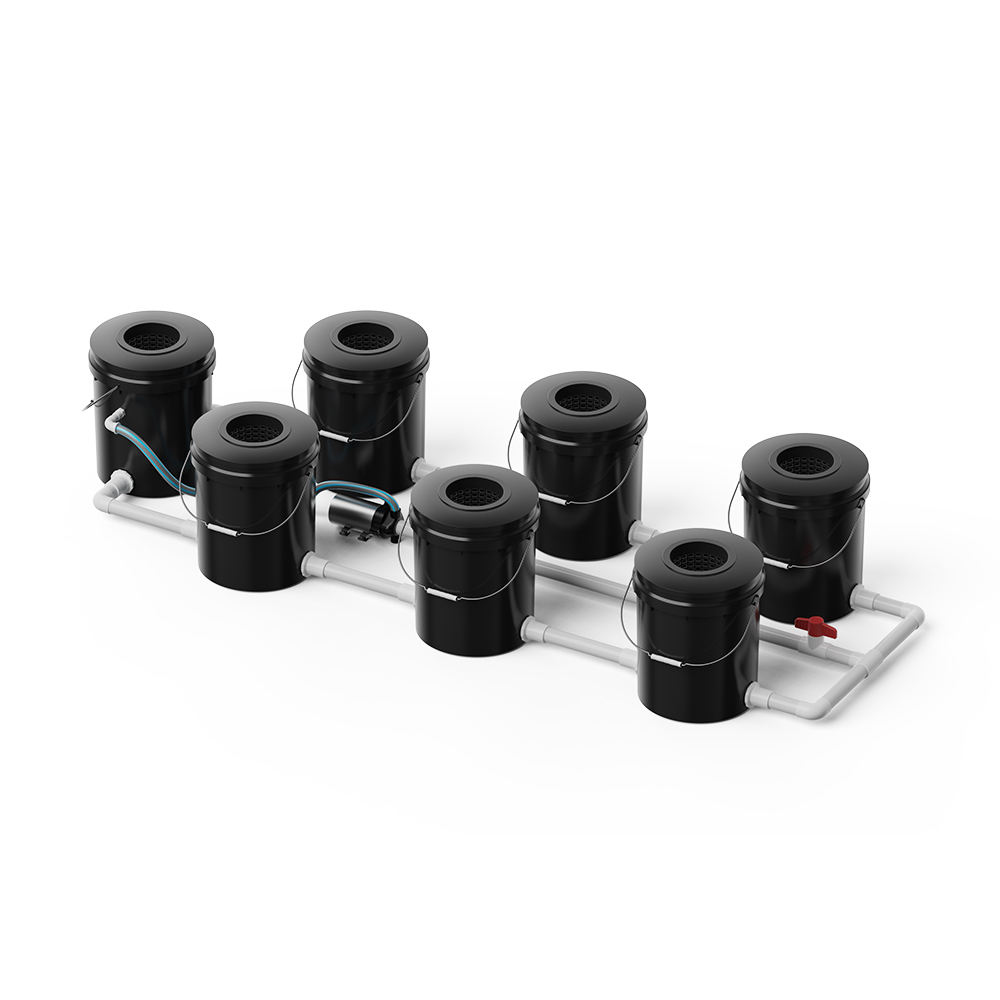
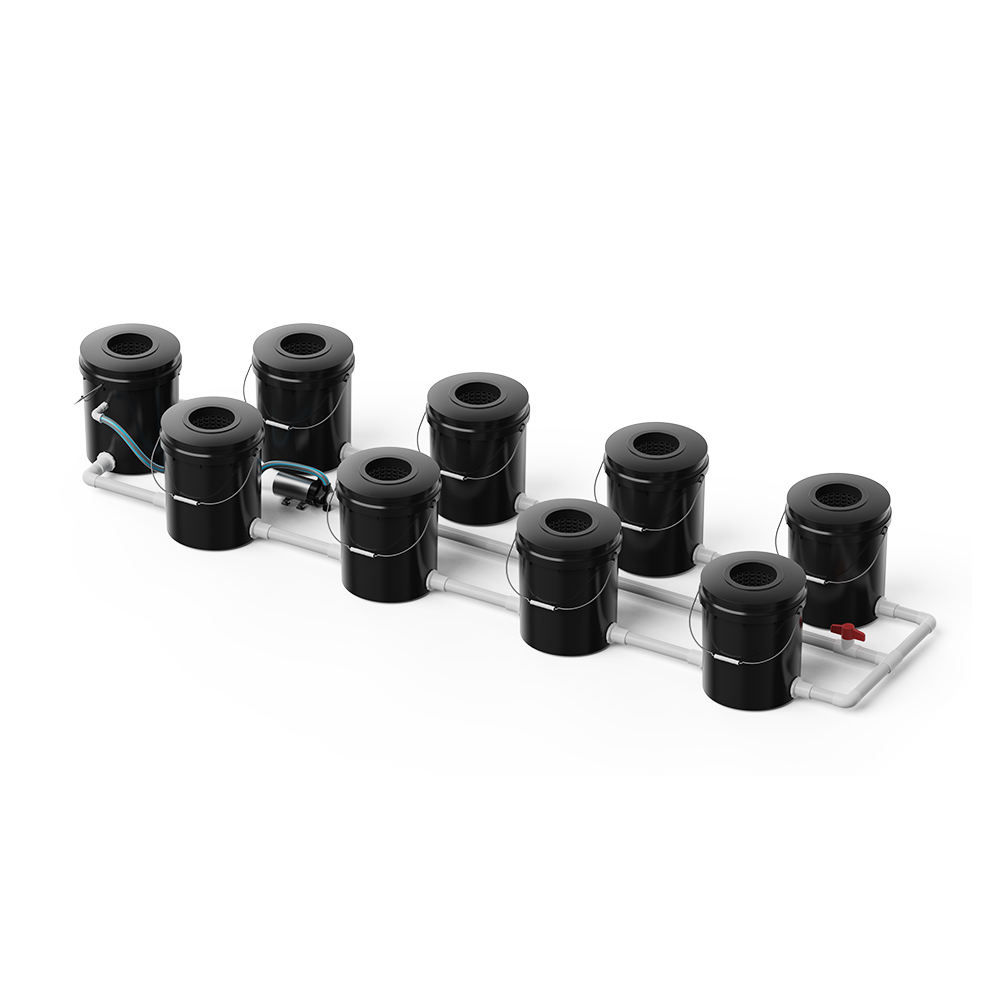
BetiLife's standard 7-Gallon / 27L RDWC line gives buyers four model references for evaluation, retail inventory and project discussions. Each model uses nominal 7-gallon planting buckets, approximately 27 liters, made from food-grade PP. The stated planting-bucket count excludes the additional reservoir, and all four standard models list an integrated drip irrigation function.
| Model and configuration | Published footprint | Practical evaluation focus |
|---|---|---|
| BLGX-04 4 planting buckets + 1 reservoir |
120 × 90 cm Approx. 4 × 3 ft |
Compact demonstration, four-site zone or initial product familiarization |
| BLGX-06 6 planting buckets + 1 reservoir |
170 × 90 cm Approx. 5.6 × 3 ft |
Mid-range retail evaluation or a six-site project requirement |
| BLGX-08 8 planting buckets + 1 reservoir |
230 × 90 cm Approx. 7.5 × 3 ft |
Eight-site demand, a longer narrow layout or a larger retail demonstration |
| BLGX-12 12 planting buckets + 1 reservoir |
240 × 130 cm Approx. 7.9 × 4.3 ft |
Twelve-site zone or a project that accommodates the wider layout |
The footprint is a starting point for planning, not the full working area. BLGX-08 uses much of a nominal 4 × 8 ft tent's length. BLGX-12 is wider than four feet and needs a larger layout. Confirm reservoir access, canopy clearance and the final installation drawing.
The published standard models list a 60W water pump rated at 3,500 L/h, with model-dependent air-pump specifications. Request the current component list rather than assuming that every pump or replacement part is interchangeable across the line.
BLGX-12 uses two export boxes, so receiving and onward delivery need to account for both. For any model, obtain the current carton dimensions, gross shipping weights and packing list when reviewing freight.
For the detailed model and price comparison, read 4 vs 6 vs 8 vs 12 Bucket RDWC: Which Model Fits Best.
Product Support With Defined Boundaries
BetiLife's published RDWC warranty and after-sales policy describes pre-shipment checks, setup guidance, troubleshooting and replacement-parts support. Eligible components have a one-year limited warranty from the applicable delivery date unless the written order terms state otherwise.
Coverage is subject to the policy and claim review. It does not guarantee crop results or business returns. Before placing an order, confirm the covered components, required evidence, remedy process, replacement availability and responsibility for related freight or labor.
That written support boundary helps a retailer plan customer service and a grower plan maintenance. It should be reviewed alongside the hardware, rather than treated as a promise that no work will be needed after delivery.
Evaluate One System Before Committing to Inventory or Expansion
An evaluation should produce a clear record of what arrived, how it was assembled and what must be resolved before the next order. Use the same acceptance standard for a complete package and a DIY build.
- Agree on the scope. Obtain the current specification sheet, itemized packing list, layout and installation instructions. Identify buyer-supplied items and who will answer integration questions.
- Record receiving condition. Check model identification, carton count and visible damage. Compare quantities with the packing list before assembly, including both boxes where a system ships in two cartons.
- Record assembly work. Follow the instructions and note labor hours, tools, missing items and unclear steps. Confirm substitutions with the supplier before making them.
- Test with clean water as instructed. Inspect connections, verify circulation and aeration at the intended sites, and check access for routine service. Follow the manual's fill-level and test procedures.
- Check maintenance access. Confirm how the system is drained, inspected and cleaned, and how serviceable parts are identified. Review any restart procedure specified by the manufacturer.
- Resolve actual support questions. Provide the model, order reference and relevant photos or video. Record the answer and any remaining action rather than assuming that a general warranty statement resolves the issue.
- Decide the next purchase. For resale, review listing readiness and customer demand. For cultivation, review the Phase 1 operating requirement and room plan. Obtain an updated quote for the agreed scope.
Do not extrapolate a single clean-water test into a crop-performance claim. Its value is establishing that the delivered equipment, instructions and support process are suitable for the next step.
Frequently Asked Questions About Complete RDWC Systems and DIY Kits
Is a complete RDWC system better than a DIY parts kit?
A complete system is often a better starting point for buyers who want a documented configuration and a defined supplier-support route. DIY can be better when the buyer has a proven design, reusable equipment or a custom requirement and can manage integration and testing. Compare scope and installed cost for the same requirement.
Does a complete RDWC system arrive ready to use?
Not necessarily. Complete systems may be shipped as separate components for on-site assembly. Confirm what is prepared at the factory, which tools or extra materials are required, and which setup and testing steps remain with the buyer.
What should a complete RDWC system quotation include?
It should identify the model, planting-site and reservoir counts, bucket capacity, supplied circulation and aeration components, footprint, electrical configuration, documentation, packaging and support terms. Record accessories and exclusions explicitly so the buyer knows what else must be sourced.
Does a complete RDWC system include grow lights, a chiller and nutrients?
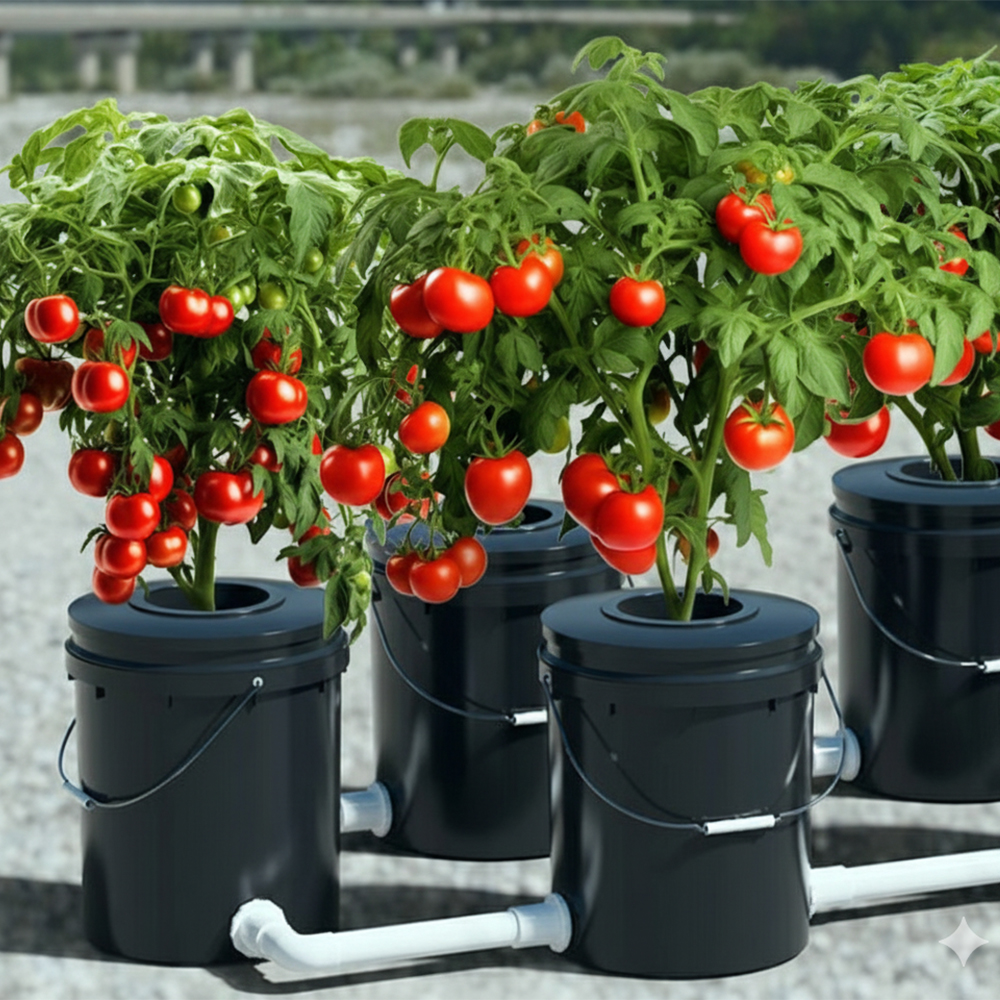
Only if the quotation and packing list say so. A complete RDWC equipment package does not automatically include the growing environment, monitoring equipment or consumables. Confirm these separately, even if a promotional image shows a planted installation.
How long does it take to assemble an RDWC system?
There is no single reliable time for every model or buyer. Assembly scope, preparation, operator experience and the installation location affect the result. Request the model's instructions and record time during a representative evaluation, including inspection and commissioning.
Will a DIY RDWC kit save money?
It may, particularly with suitable reusable equipment or an established design. Compare the full parts list, transport, preparation, paid labor and testing. A lower kit price does not establish the lower installed cost, and neither approach is automatically cheaper.
Which BetiLife model should a grow shop evaluate first?
BLGX-06 and BLGX-08 are useful candidates for stores serving mid-size or eight-site demand. BLGX-04 suits a compact evaluation, while BLGX-12 can represent an established twelve-site project opportunity. Choose the model that matches customer inquiries and available display space.
Does the 7-Gallon / 27L label mean a 27-gallon bucket?
No. It identifies the nominal seven-gallon planting-bucket platform, approximately 27 liters. It does not specify the entire system's operating water volume. Follow the model's instructions for the working water level.
Can a complete system be expanded or mixed with other parts?
Discuss the proposed configuration before ordering components. Plumbing, pumps, aeration and connections must be reviewed for the revised layout. A shared bucket capacity does not confirm compatibility or continued warranty coverage for an altered installation.
What support should a reseller confirm before ordering?
Confirm the installation resources, technical contact, spare-part identification, availability, claim evidence and written warranty scope. Also agree who handles the customer's first contact and how replacement freight and any service labor will be addressed.
Request a Complete RDWC System Quotation From BetiLife
For grow shops and distributors: tell us whether you already sell complete RDWC systems and which model interests you. Include the evaluation or inventory quantity and U.S. delivery ZIP code. If you are comparing a DIY offer, share its component scope so the comparison uses the same requirement.
Request a Dealer Evaluation Quote
For commercial growers and project buyers: send your target planting-site count, usable room length and width, crop, delivery location and planned first installation. Mention any equipment you intend to reuse and any need for separate nutrient zones.
Contact BetiLife for a Full-System Quotation
For either request, identify your preferred delivery timing and whether you want to discuss DDP or FOB quotation options. BetiLife can review the model, quantity, packing list and order structure before preparing the relevant commercial offer.
Contact JianHong Tan, Founder & Sales General Manager, at jianhongtan@betilife.com, message BetiLife on WhatsApp, or use the contact form.
Product References and Further Reading
- BetiLife 7-Gallon / 27L RDWC Collection: standard configurations and published specifications.
- BetiLife RDWC Supply for Grow Shops and Distributors: evaluation, wholesale and channel discussions.
- BetiLife RDWC Warranty and After-Sales Policy: coverage, support and claim conditions.
- Oklahoma State University: Electrical Conductivity and pH Guide for Hydroponics: source-water and nutrient-monitoring background.
- How to Choose a Commercial RDWC System for Your Grow Room: room layout and project planning.
Product references were reviewed September 16, 2026. The purchasing comparisons and labor example are decision aids, not laboratory test results. Confirm the latest specification sheet, packing list and written order terms for the selected configuration.